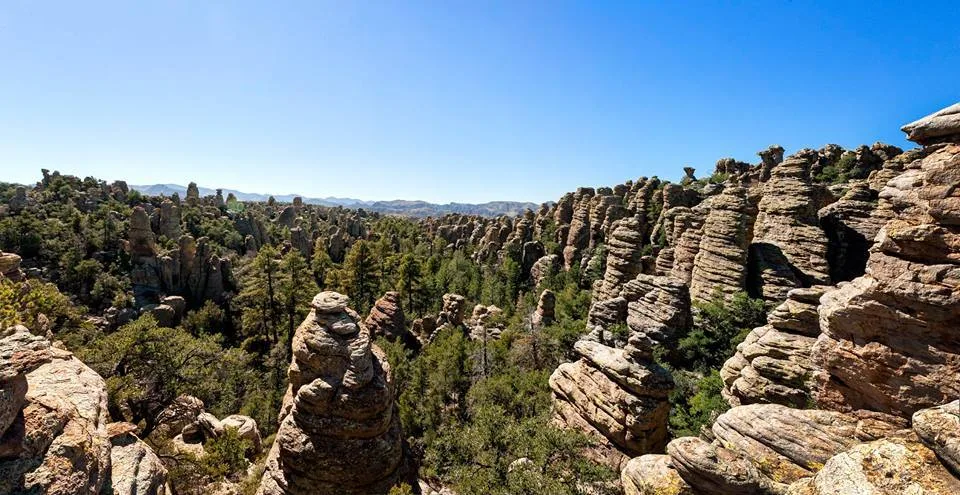
For 102 years, the signs at the entrance to the Wonderland of Rocks said Chiricahua National Monument. On October 20, 2026, an hour after President Trump signed the bill that changed that, Interior Secretary Doug Burgum and Representative Juan Ciscomani stood in Cochise County and pulled the cover off the first sign that said National Park.
Burgum told reporters that rebranding the signage would be the first order of business. Much of what follows is just as practical, and less of it is settled.
Chiricahua is now the 64th U.S. national park, Arizona's fourth after Grand Canyon, Petrified Forest, and Saguaro, and the first new national park since New River Gorge in December 2020. Here is what the law actually does, what it leaves alone, and what it means if you're planning a trip.
The Signing and the Ceremony
"Chiricahua will now stand as America's newest national park, its 64th national park," Burgum said at the dedication, according to the Arizona Daily Star. After the signs, he said, the next priorities were new water systems and other maintenance projects.
The paperwork will take longer than the signs. Days after the signing, plenty of the park's own NPS web pages still say Monument.
2021 to 2026
Senator Mark Kelly, with Senator Kyrsten Sinema, first introduced a Chiricahua National Park bill on April 22, 2021. The boundary map the final law still points to is dated March 2021. Kelly and Sinema introduced it again on March 9, 2023. Neither version became law.
The version that finally passed was H.R. 6380, introduced in the House by Representative Ciscomani on December 3, 2025. The House approved it by voice vote in March 2026. The Senate passed it by unanimous consent on September 30. The President signed it on October 20.
Plan the Newest National Park
Entry is free, the scenic drive is 8 miles, and the best single hike is 3.3. The trip planner builds a Chiricahua day around the weather and your pace.
Open the Trip PlannerA New Name on the Same Ground
The act designates the monument created by President Coolidge's 1924 proclamation as Chiricahua National Park. The boundaries stay exactly where the monument's were. Any federal law, map, or record that says Chiricahua National Monument now counts as saying Chiricahua National Park, and any money already available for the monument is available for the park. The park is still managed under the original 1924 proclamation and the 1938 one that expanded it, along with the laws that apply to every national park.
The one section with new substance is about tribal access. The Interior Secretary has to protect traditional cultural and religious sites in the park, consult with tribes, and provide access for traditional cultural and customary uses. On a tribe's request, the Secretary can temporarily close specific areas to the public, limited to the smallest area and shortest time needed.
The Congressional Budget Office estimated that establishing the park would cost less than $500,000.
Staff, Funding, and Who Gets a Say
Willcox mayor Greg Hancock told the Associated Press the change could bring more customers to the town's hotels, restaurants, and small businesses. The Park Service declined to tell the AP whether it would hire more staff to handle more visitors, and the AP reported that maintenance projects at Chiricahua had been ranked low priority. Burgum pointed to a possible Great American Outdoors Act 2.0 in Congress as the funding answer, and Ciscomani said he would make it a priority.
The land is within the historical territory of the Chiricahua Apache. The San Carlos Apache Tribe took no formal position on the designation, a spokesperson told the AP, and pointed to the tribe's 2024 testimony to Congress asking for uninterrupted access. "National parks have become so packed with tourists," Deputy Attorney General Justine Jimmie testified. "In contrast, we go to our cultural areas in what are now parks to seek sanctuary, pray, and perform ceremonies." Ciscomani told the AP the specifics of how any closures would work had not been decided.
What Changes for Your Trip
Entry is still free. NPS says Chiricahua has no entrance or parking fees and sells no passes. The only fee is for Bonita Canyon Campground, which is reservation only on Recreation.gov and often fills in March and April.
The crowds have room to grow. NPS counted 70,407 recreation visits in 2025, a little more than the roughly 60,000 a year the AP reported. March is the busiest month by a wide margin, with about 13,300 visits in 2025. July and August are the quietest, at about 2,400 to 2,600 visits a month during the summer monsoon. If national park status brings the bump Willcox is hoping for, a quiet fall weekend here may not stay quiet for long.
- Signed into law OCT 20, 2026
- National park number 64TH
- Monument since APR 18, 1924
- Entrance fee NONE
- Visits in 2025 70,407
Law text from H.R. 6380 as reported (govinfo.gov); earlier bills S. 1320 (117th Congress) and S. 736 (118th Congress) on govinfo.gov. Votes, CBO estimate, staffing, tribal testimony, and the Hancock and Ciscomani remarks from the Associated Press (Oct. 8, 2026). Burgum's remarks from the Arizona Daily Star and KOLD. Fees, campground, and park facts from NPS.gov; 2025 monthly visitation from NPS IRMA figures published by Northern Arizona University. Visitation differs by source: NPS counted 70,407 in 2025 and the AP reported roughly 60,000, so we used the NPS figure and noted the AP number. The AP also dated New River Gorge to 2021; it was designated in December 2020. Photos: NPS, public domain.
The new sign at the entrance took one afternoon. The rocks behind it took about 27 million years, and in a century the name on them has changed only once. It still costs nothing to walk in and see them.