Ticket · Recreation.gov
Natural Entrance Tour
Moderate
0.6 mi-300 stairs~1.25 hr
A ranger-guided walk down through the cave's original opening, past dense boxwork formations, exiting by elevator.
 National
South Dakota · Park 35 / 64
One of the world's longest, most complex caves, breathing through a single opening, under a mixed-grass prairie full of bison.
The cave's name comes from a real phenomenon: air moves in and out of the single known natural entrance in response to changes in barometric pressure outside, sometimes forcefully enough to be felt as an actual wind. Below ground lies one of the longest and most complex cave systems ever mapped, famous for boxwork, a rare formation of thin calcite blades forming honeycomb-like patterns that occurs here in greater concentration than almost anywhere else on Earth.
Above ground is an entirely different park: 33,970 acres of mixed-grass prairie, one of the last intact remnants of that ecosystem in North America, home to bison, elk, pronghorn, and prairie dog towns. Every cave tour is ranger-guided and ticketed, sold through Recreation.gov up to 120 days in advance, with roughly half held back for same-day walk-up sales that routinely sell out by mid-morning in peak season.
Come for the boxwork below. Stay for the bison above. Read the story, book your cave tour well ahead, and when you leave, mark it visited.

The cave is central to the Lakota emergence story, on their ancestral homeland, long before it became the country's first cave designated as a national park.Adapted from Black Hills Parks & Forests Association interpretive materials
Six ways to spend your time, split between a cave tour below and a prairie full of bison above.
A ranger-guided walk through the cave's boxwork-rich passages, entering through the historic natural opening.
Ticket required · book aheadThe park's main roads cross open prairie where bison herds cross regularly, sometimes causing a full stop.
The signature driveA short loop to the park's highest point and a historic fire tower with views across the Black Hills.
Everyone · 1 hrA strenuous, headlamp-and-crawl summer tour into undeveloped cave passages, for those comfortable in tight spaces.
Advanced · summer only, ticketedAn active black-tailed prairie dog colony visible right from the roadside, a reliable and easy wildlife stop.
Families · 15 minDisplays on both the cave's geology and the prairie's ecology, a good stop before or after your ticketed tour.
Everyone · 30 minAnswer a few questions right here. We'll map your day, stop by stop, with a route, timings, weather, and a packing checklist grounded in real park data. No account, no leaving this page.
⚡ In a hurry? Adventure Light 5 questions →Every route rated honestly, with distance, climb, and a clear note on which cave tours need advance tickets.
A ranger-guided walk down through the cave's original opening, past dense boxwork formations, exiting by elevator.
The gentlest standard tour, entered and exited by elevator, a good choice for families or those wary of stairs.
A loop to the park's highest point, with a historic fire lookout and views across the surrounding Black Hills. No permit.
A flat loop near the visitor center through mixed-grass prairie, good for spotting prairie dogs. No permit.
A quiet out-and-back through a limestone canyon, good for birdwatching away from the cave-tour crowds. No permit.
A strenuous, unlit exploration into undeveloped passages requiring crawling through tight spaces. Not for claustrophobia; helmet and headlamp provided.
All cave tours require a ticket sold via Recreation.gov (about half same-day walk-up at the visitor center) · no permit for surface trails · free park entry
Tap any animal to learn its story. Soon, the app will let you log what you spot and keep a life list for every park.
A resident herd roams the park's rolling prairie, frequently crossing roads and causing what locals call a South Dakota traffic jam.
Lives in visible burrow towns near the main roads, a keystone species supporting the park's broader prairie food web.
Reintroduced to the park's prairie dog colonies as part of a major endangered-species recovery effort, rarely seen but present.
Found in the forested hillsides bordering the prairie, most active and vocal during the fall rut.
The fastest land animal in North America, grazing the park's open prairie sections.
Lives in the dim entrance areas of the cave where some light still reaches, part of a specialized cave-edge community.
Common in the wooded ravines between prairie sections, often seen in small flocks near the campground.
Dominates the park's remnant mixed-grass prairie, one of the last large intact stretches of this ecosystem in North America.
Adds yellow color to the prairie each summer, common along the park's grassland trails.
Covers the rockier hillsides and draws throughout the park, contrasting with the open prairie below.
A common prairie plant with tall flower stalks, historically used by Indigenous peoples for fiber and food.
Found in the driest sections of the prairie, blooming bright yellow in early summer.
A lavender-flowered prairie plant popular with pollinators, often found growing alongside prairie coneflower.
Wind Cave was designated in 1903, the first cave anywhere in the world to become a national park.
The cave contains the largest known concentration of boxwork, a rare calcite formation, found almost nowhere else on Earth in this density.
Air moves through the cave's single known natural entrance in response to barometric pressure changes outside, the source of the cave's name.
The park's 33,970 acres protect one of the last intact remnants of mixed-grass prairie left in North America.
The questions people actually ask, answered from the park’s own current guidance. Fees and permit rules change every year, so each answer links back to the National Park Service page it came from.
No. You can drive through, hike the trails, and visit the visitor center for free, and no entrance pass is required. Fees only apply if you take a cave tour or camp. Source: NPS.gov
It's worth booking ahead, though it's not strictly required. Recreation.gov reservations open 120 days in advance and close 2 days before the tour, and only about half of the Garden of Eden, Natural Entrance, and Fairgrounds tour slots are held for advance booking, the rest go on sale first-come, first-served at the visitor center the same day. Source: NPS.gov
Yes, tour times and offerings vary by time of year, so it's worth calling the park at (605) 745-4600 to confirm times before you go. Winter storms can also bring snow that temporarily closes park roads. Source: NPS.gov
Very likely. Several hundred bison roam the park's rolling prairie, along with elk and other wildlife, so keep an eye out along the park roads, especially early morning or evening. Source: NPS.gov
Stories, guides, and hard-won tips from the trail. The full Wind Cave deep dive lives on the blog.
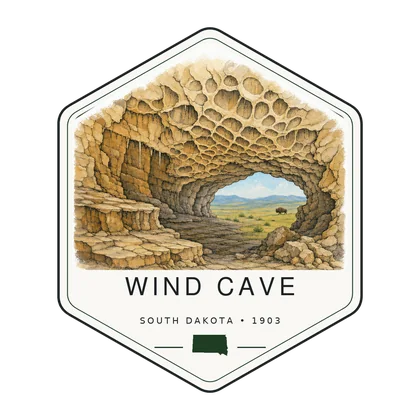
Log the visit, keep your story, and watch the map of all sixty-four fill in behind you. Every visit has a keepsake worth holding.
An hour northeast: from a cave that breathes to a landscape eroding in real time.
Open Park 31 → The collectionSee the full map and track every park you have visited.
View the map → PlanTurn Wind Cave into a road trip with a custom, day-by-day itinerary.
Start planning → Go deeperWind Cave holds more boxwork than any cave known on Earth. The Park Service itself calls how it formed one of the cave's biggest mysteries.
Read it →
Offline maps, your passport, and every park in your pocket on the trail.
Join the waitlist →
The printed edition, part atlas, part journal, one story per park.
Notify me →Park-guide posters, enamel stamps, and the passport book to fill in.
Visit the shop →Field Notes
The parks do not perform for anyone. They stood here before the road, and they will stand here after it.