Badwater Basin Salt Flats
Easy
1.5 miflat~1 hr
A flat out-and-back onto the salt flats from the lowest parking lot in North America. Avoid midday in summer entirely. No permit.
 National
California · Park 21 / 64
The hottest, driest, lowest place in North America, and somehow one of the most beautiful.
Badwater Basin sits 282 feet below sea level, the lowest point in North America, and on a summer afternoon the ground temperature there has been measured well over 200 degrees Fahrenheit. The valley's shape traps and compresses air as it sinks, and the surrounding peaks block ocean moisture entirely, which is why Death Valley holds the record for the hottest air temperature ever reliably recorded on Earth.
None of that makes it empty. More than a thousand plant species grow here, several found nowhere else, and every few years enough winter rain triggers a superbloom that carpets the valley floor in gold and purple for a few unpredictable weeks. The same geology that makes the heat so extreme also produces some of the most striking badlands and canyon color in the Southwest, at Zabriskie Point and Artists Palette alike.
Come for the extremes. Stay for the fact that a landscape this hostile is also this beautiful. Read the story, take the heat warning above seriously, and when you leave, mark it visited.

Death Valley: the very name summons up images of a desolate and lifeless land ... in truth the valley is full of life and color, changing dramatically from hour to hour and season to season.Adapted from National Park Service interpretive materials on Death Valley
Six ways to spend your time, from the lowest point in North America to a viewpoint 5,000 feet above it.
A salt-flat walk 282 feet below sea level, the lowest point in North America. Early morning or evening only in warmer months.
The signature stopGolden badlands eroded into impossible textures, best when the low sun rakes across the ridges.
Photographers · dawnA one-way scenic loop past Artists Palette, where mineral oxidation paints the hillsides pink, green, and purple.
Casual · road-trippersRolling dunes near Stovepipe Wells, best at sunrise or sunset when the light and temperature both cooperate.
Everyone · dawn or duskA viewpoint over a mile above Badwater Basin, cool even when the valley floor is unbearable.
Everyone · half dayThe park's most developed campground, with access to the visitor center and the world's lowest golf course. Reserve for winter.
Campers · winter seasonAnswer a few questions right here. We'll map your day, stop by stop, with a route, timings, weather, and a packing checklist grounded in real park data. No account, no leaving this page.
⚡ In a hurry? Adventure Light 5 questions →Every trail rated honestly, with distance, climb, and a blunt reminder: this park has killed unprepared hikers. Carry water accordingly.
A flat out-and-back onto the salt flats from the lowest parking lot in North America. Avoid midday in summer entirely. No permit.
A short paved climb to the classic badlands overlook, worth timing for sunrise light. No permit.
No marked trail; walk as far into the dunes as you like. Sand holds heat, so dawn or dusk only in warmer months. No permit.
A narrow canyon of golden badlands leading toward Zabriskie Point's Red Cathedral formation. No permit.
A short walk among the mineral-streaked hillsides accessible from the Artists Drive loop road. No permit.
The park's highest point at 11,049 feet, often snow-covered in winter when the valley floor bakes below. No permit required but winter mountaineering gear may be necessary.
No permit for day hikes · free backcountry permits recommended for overnight camping · summer hiking after 10am strongly discouraged park-wide
Tap any animal to learn its story. Soon, the app will let you log what you spot and keep a life list for every park.
One of the rarest fish on Earth, living in a single geothermal pool and nowhere else on the planet, a relic of ancient lakes that once filled the valley.
Survives on remarkably little water, working the steep canyon terrain where few other large mammals can follow.
Hunts only at night to avoid the worst heat, with oversized ears that help radiate excess body warmth.
Spends much of its life underground avoiding surface heat, emerging mainly during the cooler months to feed.
One of many beetle species adapted to survive on the valley's dunes and salt flats, active mostly after sundown.
Thrives near developed areas, scavenging effectively enough to be one of the valley's most visible birds year-round.
A separate pupfish species surviving in a tiny, hypersaline creek, tolerating water conditions that would kill most freshwater fish.
One of the standout wildflowers of a rare wet-winter superbloom, carpeting the valley floor in gold for a few unpredictable weeks.
Deep-rooted enough to tap groundwater far below the surface, anchoring the sand at Mesquite Flat and giving the dunes their name.
One of the longest-lived plants on Earth, some individual clonal rings estimated at over 10,000 years old.
A pink, bell-shaped bloom that appears after sufficiently wet winters, one of the park's most photographed wildflowers.
Grows near Telescope Peak's summit, among the oldest living trees on Earth, some individuals exceeding 3,000 years.
A large-flowered daisy nearly endemic to the park's canyons, rare enough that sightings are noted by park botanists.
Badwater Basin sits 282 feet below sea level, the lowest point in North America.
Death Valley holds the record for the hottest reliably recorded air temperature on Earth, 134°F at Furnace Creek in 1913.
The park is the largest national park in the contiguous United States at over 3.3 million acres.
A rare superbloom after sufficiently wet winters can carpet the valley floor in wildflowers, an event that may not repeat for a decade.
The questions people actually ask, answered from the park’s own current guidance. Fees and permit rules change every year, so each answer links back to the National Park Service page it came from.
A private vehicle pass is $30 for 7 days. Motorcycles are $25, and people arriving on foot or bike pay $15 each. Only credit/debit cards or digital payment are accepted at the gate, no cash. Source: NPS.gov
No, there's no reservation or permit needed just to enter and drive around Death Valley. You only need a permit if you plan to do things like backcountry camping in certain areas or commercial filming; regular sightseeing and day hiking don't require one. Source: NPS.gov
Yes, and the park is direct about it: summer temperatures on the valley floor can hit 130°F with lows still near 90°F at night, and even hiking in the 80s and 90s can be deadly at low elevation. NPS advises against hiking in the valley when it's hot, recommends drinking at least a gallon of water a day, and suggests sticking to higher-elevation trails like Wildrose or Telescope Peak if you're visiting in summer. In 2024 the park averaged a high of 117.3°F with 37 days over 120°F. Source: NPS.gov
Death Valley holds the record for the hottest air temperature ever reliably recorded on Earth: 134°F, measured on July 10, 1913, at Furnace Creek. That's the reading NPS itself cites for the park's claim as the hottest place on the planet. Source: NPS.gov
Stories, guides, and hard-won tips from the trail. The full Death Valley deep dive lives on the blog.
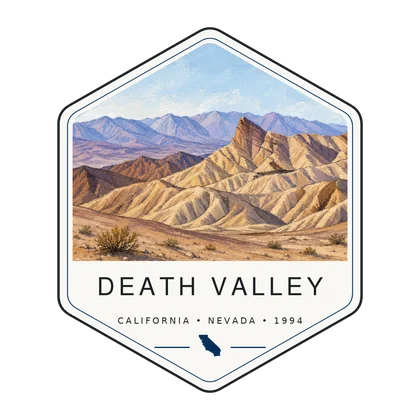
Log the visit, keep your story, and watch the map of all sixty-four fill in behind you. Every visit has a keepsake worth holding.
South across the Mojave: from the lowest point in North America to a desert of granite boulders.
Open Park 13 → The collectionSee the full map and track every park you have visited.
View the map → PlanTurn Death Valley into a road trip with a custom, day-by-day itinerary.
Start planning → Go deeperNobody saw one move for decades. Two cousins with GPS trackers finally caught it happening.
Read it →
Offline maps, your passport, and every park in your pocket on the trail.
Join the waitlist →
The printed edition, part atlas, part journal, one story per park.
Notify me →Park-guide posters, enamel stamps, and the passport book to fill in.
Visit the shop →Field Notes
The parks do not perform for anyone. They stood here before the road, and they will stand here after it.