Hidden Valley Nature Trail
Easy
1 mi+100 ft~45 min
A loop through a boulder-ringed bowl with interpretive signs on the desert's rock and plant life. No permit.
 National
California · Park 13 / 64
Two deserts meet here, a hard line drawn across the sand, and a strange spiky tree stands guard on either side.
Drive through this park and you cross an invisible line partway: the low, hot Colorado Desert gives way to the higher, cooler Mojave, and the boundary is almost exact. South of it, cholla and ocotillo dominate. North of it, the Joshua tree takes over, a member of the yucca family that can live for centuries and blooms only when a rare hard freeze triggers it.
The rock piles that make this park famous, jumbled towers of monzogranite, formed underground as magma cooled slowly and cracked into blocks, then were exposed as softer surrounding rock eroded away over millions of years. Climbers have been drawn here since the 1950s, and the same boulders that challenge them today shape the landscape into something that looks almost designed.
Come for the surreal rock gardens. Stay for the dark sky, some of the darkest within driving distance of Los Angeles. Read the story, trust the live data above for what is open today, and when you leave, mark it visited.

The desert is not a wasteland, but a mysterious and lovely place, waiting for people to see it with more than their eyes.Adapted from Minerva Hoyt, whose advocacy led to the park's 1936 protection as a national monument
Six ways in, from a boulder scramble at sunset to a night flat on your back under the Milky Way.
A short drive to a ridge overlook of the Coachella Valley, the Salton Sea, and on clear days, Mexico's mountains far to the south.
Everyone · 30 minA rock-ringed bowl that once reportedly hid stolen cattle. Easy walking with endless boulders to climb along the way.
Families · rock scramblersAn International Dark Sky Park with some of the darkest skies within reach of Los Angeles. New moon nights are best.
Stargazers · after darkThe main road through Hidden Valley, the Wonderland of Rocks, and Skull Rock, with pullouts at every strange formation.
Casual · road-trippersSites tucked directly among the boulders, some of the best car camping anywhere in the desert Southwest. Reserve ahead in cooler months.
Campers · book earlyA dense field of teddy-bear cholla glowing gold at sunrise and sunset, where the Colorado Desert meets the Mojave.
Everyone · 20 minAnswer a few questions right here. We'll map your day, stop by stop, with a route, timings, weather, and a packing checklist grounded in real park data. No account, no leaving this page.
⚡ In a hurry? Adventure Light 5 questions →Every trail rated honestly, with distance, climb, and a reminder to carry more water than the desert makes you think you need.
A loop through a boulder-ringed bowl with interpretive signs on the desert's rock and plant life. No permit.
Past an old ranchers' dam and petroglyphs to a seasonal pool that reflects the surrounding rock when it holds water. No permit.
Winds past the famous eroded formation and through classic Joshua Tree boulder country the whole way. No permit.
The best view-per-step in the park, a steady climb to a summit overlooking three of the park's major valleys at once. No permit.
A loop past an old gold mine to a rock-pile summit with views over the Cottonwood Spring oasis and the Eagle Mountains. No permit.
A long, exposed desert walk to the park's largest native fan-palm oasis, hidden in a canyon that looks nothing like the rest of the trail. No permit.
Free backcountry permits at trailhead boards for overnight camping · no permit for day hikes
Tap any animal to learn its story. Soon, the app will let you log what you spot and keep a life list for every park.
Small, scattered populations work the rugged terrain near the Wonderland of Rocks and the Little San Bernardino Mountains, rarely seen but present.
The desert's most adaptable predator, working campgrounds and washes alike. Never feed one; it shortens their lives and changes their behavior fast.
Spends up to 95 percent of its life underground avoiding the heat. A federally threatened species; if you see one, do not touch or move it.
A large, flat-bodied lizard that wedges itself into rock cracks and inflates its body to lodge in place when threatened.
A real bird, not just a cartoon: sprints across the desert floor at up to 20 mph chasing lizards and snakes.
Uses its oversized ears as a radiator to dump body heat in the desert night, common along nearly every road at dusk.
Moves in a distinctive sideways motion adapted to loose desert sand, leaving a signature S-shaped track. Give any snake a wide berth.
A giant yucca that can live for centuries, blooming only after a rare hard winter freeze. Found mainly on the Mojave, higher side of the park.
The golden, fuzzy-looking cactus filling the Cholla Cactus Garden. The spines detach at the lightest touch; look, never pet.
A cluster of thorny wands that stay bare most of the year, then leaf out and bloom bright red within days of a good rain.
A rare pink, bell-shaped bloom that appears after wet winters, one of the park's most photographed spring wildflowers.
The state's only native palm, found exclusively at desert oases fed by fault-line springs, like Lost Palms and the Oasis of Mara.
Shorter and sharper-leaved than the Joshua tree, with a single flowering stalk that once supplied fiber and food to desert peoples.
The park straddles two distinct deserts, the Mojave and the Colorado, meeting along an almost visible boundary line.
The famous granite boulders are monzogranite, cooled underground and exposed over millions of years as softer rock eroded away.
Joshua trees are pollinated almost exclusively by the yucca moth, a relationship so specific that neither species can easily survive without the other.
The park is an International Dark Sky Park, and on a clear new-moon night the Milky Way is visible without any equipment at all.
The questions people actually ask, answered from the park’s own current guidance. Fees and permit rules change every year, so each answer links back to the National Park Service page it came from.
A private vehicle pass is $30 for 7 days, a motorcycle is $25, and a person on foot or bike pays $15. An annual park pass is $55, and kids under 16 walking or biking in don't need a pass. Source: NPS.gov
There's no snow-driven road closure season here, but summer, roughly June through September, brings high temperatures and long, hot days, and NPS specifically tells visitors to plan ahead for a safe visit during that stretch. Heat, not weather closures, is the main seasonal issue at this park. Source: NPS.gov
Yes, it's an International Dark Sky Park, and NPS calls out its dark night skies, some of the darkest in Southern California, as one of the park's defining features. Get away from the parking areas and campgrounds for the best views. Source: NPS.gov
The West Entrance, near the town of Joshua Tree, is the park's busiest and often has long lines. NPS suggests using the North Entrance near Twentynine Palms instead, which typically has little to no wait. Source: NPS.gov
Stories, guides, and hard-won tips from the trail. The full Joshua Tree deep dive lives on the blog.
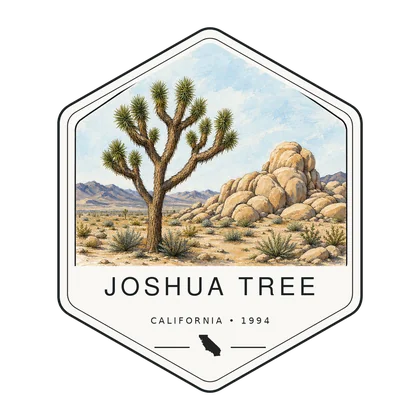
Log the visit, keep your story, and watch the map of all sixty-four fill in behind you. Every visit has a keepsake worth holding.
East across the desert Southwest: from granite boulders to sandstone doorways.
Open Park 08 → The collectionSee the full map and track every park you have visited.
View the map → PlanTurn Joshua Tree into a road trip with a custom, day-by-day itinerary.
Start planning → Go deeperA murder pardoned by a mystery novelist, a fault line rearranging the view, and rock shaped by an underground ice cube trick.
Read it →
Offline maps, your passport, and every park in your pocket on the trail.
Join the waitlist →
The printed edition, part atlas, part journal, one story per park.
Notify me →Park-guide posters, enamel stamps, and the passport book to fill in.
Visit the shop →Field Notes
The parks do not perform for anyone. They stood here before the road, and they will stand here after it.