Walk out onto the boardwalk at Badwater Basin and the ground reads like a punishment: cracked white salt stretching toward mountains that shimmer in heat that regularly tops 120 degrees. A small spring-fed pool sits near the parking area, and it's easy to walk right past it. That pool is the reason the whole basin has the name it does, and it's the last place you'd expect to find something alive.
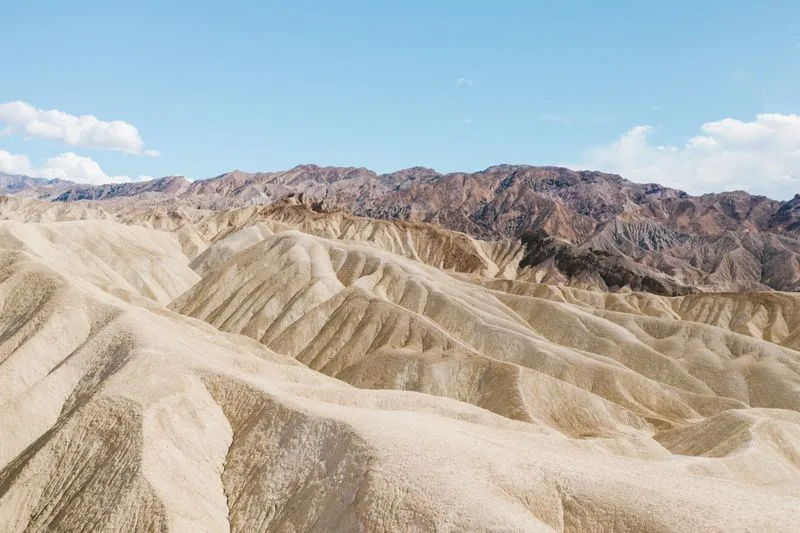
At 282 feet below sea level, Badwater Basin is the lowest point in North America. That fact alone gets it on every itinerary. What doesn't always make the itinerary is that this exact spot, the hottest and driest basin on the continent, has been continuously wet in one small corner for long enough that a species of snail evolved here and lives nowhere else on Earth.
The Name Isn't About Poison
The basin's name traces back to an early surveying party whose mule refused to drink from the spring-fed pool. The water wasn't poisonous or contaminated. It was simply salty enough that the mule wanted no part of it, and the name stuck to the whole basin long after anyone remembered which survey it came from. NPS is direct about the correction: the water here is not truly bad, just very salty, salty enough that a working animal knew to turn its head away.
Lake Manly's Long Evaporation
Long before anyone named it, this basin held an actual lake. Lake Manly, named for the same 1849 prospecting party the valley itself is named for, had already evaporated tens of thousands of years before those prospectors arrived. The lake had no outlet, so every mineral that ever washed into it stayed there, concentrating as the water slowly disappeared into the desert air. What's left now is nearly 200 square miles of salt flat, made mostly of sodium chloride, ordinary table salt, mixed with calcite, gypsum, and borax. Groundwater still rises up through those old deposits and evaporates at the surface, which is what keeps forming the sharp, geometric salt polygons visible from the boardwalk today.
Time Your Badwater Visit
Midday heat here is no joke. The trip planner can help you catch the salt flats at sunrise, when the light and the temperature both work in your favor.
Open the Trip PlannerThe Badwater Snail
The pool the surveyor's mule turned away from still exists, and it still supports life that exists nowhere else on the planet. The Badwater snail, first formally described by S.S. Berry in 1947, is endemic to Badwater Basin, found only near this spring source and nowhere else in the world. It survives completely submerged in the spring water, in a pool sitting inside a basin that averaged a high of over 117 degrees in 2024 and holds the record for the hottest air temperature ever reliably measured on Earth, 134 degrees, recorded at Furnace Creek in 1913. The snail's conservation status is listed as vulnerable, tied entirely to the health of this one small spring it can't leave.
- Elevation 282 FT BELOW SEA LEVEL
- Salt flat area ~200 SQ MI
- Badwater snail described 1947
- Hottest recorded temp 134°F, 1913
The View That Explains the Scale
Stand on the boardwalk and look west, and Telescope Peak rises 11,049 feet in the Panamint Range, over two miles of vertical relief above the salt you're standing on. Nowhere else in the contiguous United States packs that much elevation change into a single sightline. It's the detail that makes the basin's extremity legible in a way the number 282 alone doesn't quite manage: you're not just standing at the lowest point on the continent, you're standing at the bottom of a wall tall enough to hold snow while you sweat.
Facts and figures checked against NPS.gov's Badwater Basin page, the U.S. Fish and Wildlife Service's Badwater snail species page, and NPS's own summer-heat and temperature-record pages for Death Valley.
Walk back past that small pool on your way off the boardwalk and it's easy to see nothing but salt-crusted water in a parking lot. What's actually in there is a species that has outlasted an entire lake, surviving in the one spot in the hottest basin on the continent that never fully dried out. The mule had the right instinct. It just didn't know what it was turning away from.