In 1997, two park visitors named Steve Gasman and Jim Carney noticed bone sticking out of the dirt near the Conata picnic area, vertebrae and limb bones, clearly something large. Park paleontologists came to investigate, expecting a single animal. What they found instead was a jumble of bones from dozens of individuals, layered together in one spot, dominated early on by the skeleton of an animal everyone assumed at first was some kind of ancient pig. It wasn't. The name stuck anyway.
Over the next several field seasons, the site the team started calling the Big Pig Dig produced more than nineteen thousand fossils, making it one of the richest single deposits from its era found anywhere in the world, in a park whose rock already ranks among the best-studied Oligocene fossil beds on Earth.
Not Actually a Pig
The animal behind the nickname was Archaeotherium, a heavy-jawed, boar-shaped creature that's actually more closely related to hippos than to any true pig. Paleontologists nicknamed it the "terminator pig" for its massive skull and jaw, built for crushing rather than precision, and current thinking treats it as more likely an opportunistic scavenger than an active predator despite its intimidating build. Alongside its remains, the dig turned up Subhyracodon, an early hornless relative of rhinos, Mesohippus, a dog-sized ancestor of the modern horse, and Leptomeryx, a small deer-like animal with the unusual feature of saber-like teeth.
A Forest That Became a Prairie
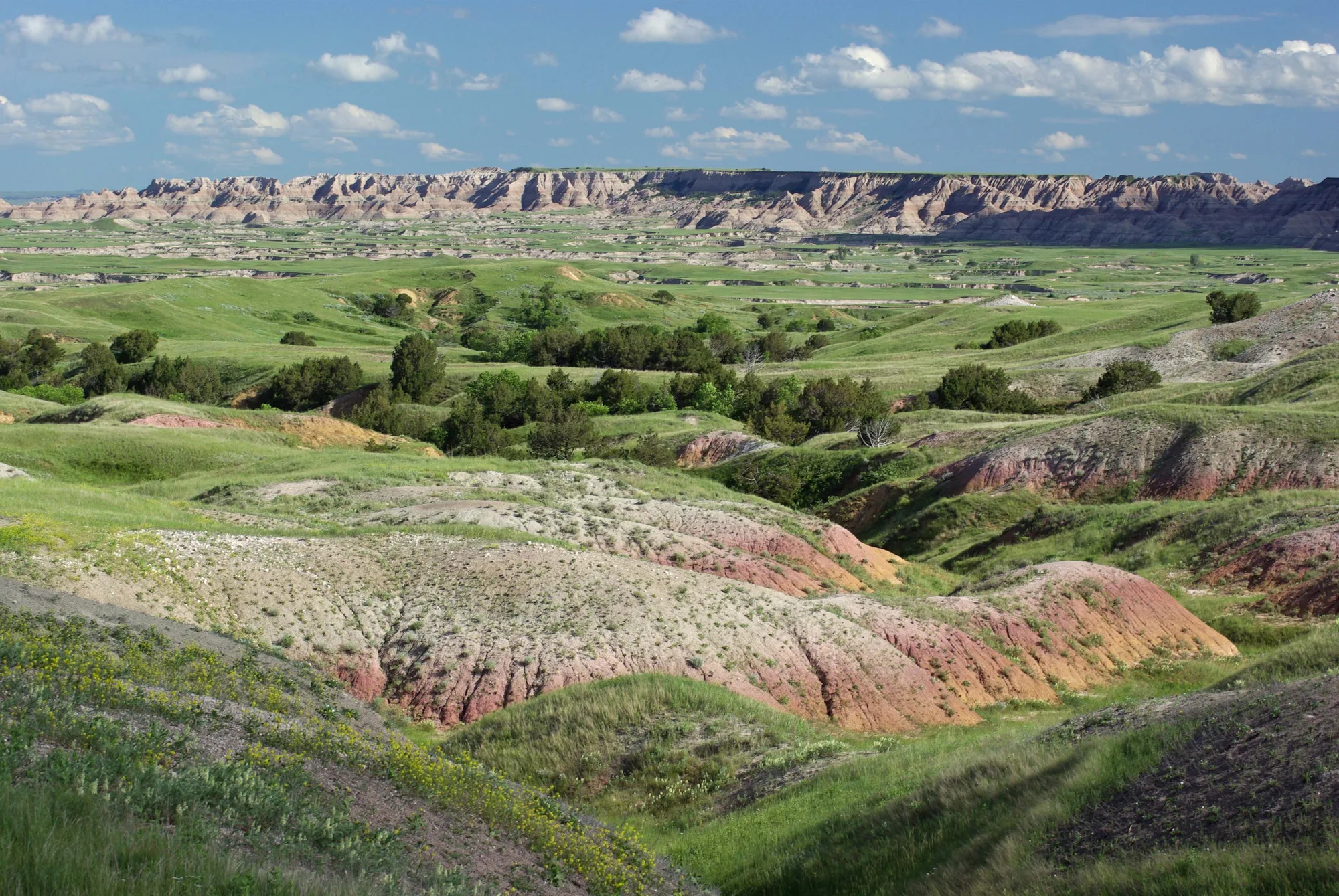
The White River rock exposed throughout Badlands preserves roughly thirty-five to twenty-three million years of Oligocene history, a span geologists consider one of the richest mammal fossil records from that epoch found anywhere on the planet. Early in that window the climate here was warm and humid, supporting genuine subtropical forest. By the middle and later Oligocene, the climate had dried out considerably, and the landscape opened into something closer to savanna and open grassland, the same transition that, played out globally, eventually produced the grazing prairie mammals recognizable today. The Big Pig Dig's animals lived right in the middle of that shift, a fact you can read directly out of the layers the bones came from.
- Big Pig Dig discovered 1997
- Fossils recovered there 19,000+
- Oligocene span preserved ~35-23 MYA
- New species named MAY 2024
Plan Your Fossil Exhibit Trail Stop
The Fossil Exhibit Trail is an easy boardwalk loop with real cast fossils on display along the way. The trip planner can help you fit it into a North Unit day.
Open the Trip PlannerThe Fossil Prep Lab
Inside the Ben Reifel Visitor Center, the park runs a working Fossil Preparation Lab through the summer season, where visitors can watch paleontologists and interns clean and stabilize actual fossils pulled from the surrounding badlands, and ask questions face to face while they work. It's a rare kind of transparency for an active research program, the fossils on the other side of the glass aren't replicas or museum pieces already fully processed, they're specimens still partway through becoming part of the scientific record.
A Deer No One Had Named
In May 2024, the park announced a newly named species, Santuccimeryx elissae, a small ruminant that lived roughly thirty-two million years ago. It was first spotted back in 2016 by Tiffany Leone, an intern working through the Geoscientists-in-the-Parks program, and it took eight more years of study before park paleontologists Mattison Shreero and Ed Welsh, working with researchers from the American Museum of Natural History and Cal Poly, formally described it in a published paper. The genus name honors Vincent L. Santucci, the National Park Service's senior paleontologist, a small piece of institutional memory folded into the animal's permanent scientific name.
Facts and figures checked against the National Park Service's own account of the Big Pig Dig and the Fossil Preparation Lab, the U.S. Geological Survey's Oligocene stratigraphy for the White River Group, and NPS's May 2024 announcement of Santuccimeryx elissae.
Nineteen thousand fossils came out of one spot near a picnic area because two people happened to look down at the right moment, and none of them, in the end, belonged to a pig. What they belonged to was a moment thirty-some million years ago when this ground was still warm enough for forest, just starting the long dry turn toward the open grassland that shapes the park today. The name never got fixed. It didn't need to. Every visitor who reads the sign still gets the joke, and the animal underneath it is stranger than a pig would have been anyway.