Valley View Overlook Trail
Easy
0.8 mi+80 ft~30 min
A short walk through dense saguaro stands to a wide valley view, one of the best easy hikes in the west district. No permit.
 National
Arizona · Park 32 / 64
The largest cactus in the United States, growing only here, standing in a forest instead of a garden.
The saguaro cactus grows nowhere on Earth outside the Sonoran Desert, and this park protects some of the densest stands of them anywhere, dense enough that early visitors described driving through what genuinely looks like a forest, just built from cactus instead of trees. A mature saguaro can live 150 to 200 years, grow over 40 feet tall, and sprout its first arm only after 50 to 75 years of growth, which means many of the tallest, most heavily armed specimens you'll see predate the park itself by a century or more.
The park is split into two separate districts on either side of Tucson, the Rincon Mountain District to the east and the Tucson Mountain District to the west, with no road connecting them inside the park. Signal Hill, in the western district, holds one of the best-preserved collections of Hohokam petroglyphs in the region, a reminder that people have read meaning into this landscape for far longer than it's been a national park.
Come for the scale of the cactus forest. Stay long enough to notice how different the two districts feel from each other. Read the story, trust the live data above for what is open today, and when you leave, mark it visited.

The saguaro, patriarch of the Sonoran Desert, stands as sentinel over a landscape most people picture as empty and find is anything but.Adapted from National Park Service interpretive writing on Saguaro National Park
Six ways to spend your time, split across two districts that couldn't be reached from each other without leaving the park.
An eight-mile paved loop through the densest saguaro stands in the Rincon Mountain District, with pullouts and short trails throughout.
The signature driveA short desert walk to boulders covered in Hohokam rock art, one of the best-preserved petroglyph sites in the region.
Everyone · 30 minA short, easy trail in the Tucson Mountain District ending at a sweeping view over a saguaro-covered valley.
Everyone · 30 minA long, exposed climb from the desert floor into pine forest, showing the park's full elevation range in one hike.
Half day · confident hikersBoth districts offer classic saguaro-silhouette sunset views; Gates Pass, just outside the west district, is a favorite.
Everyone · golden hourExhibits on the Sonoran Desert ecosystem and a good introduction before heading out into the Cactus Forest Drive.
Everyone · 30 minAnswer a few questions right here. We'll map your day, stop by stop, with a route, timings, weather, and a packing checklist grounded in real park data. No account, no leaving this page.
⚡ In a hurry? Adventure Light 5 questions →Every trail rated honestly, with distance, climb, and a note on which district each one belongs to.
A short walk through dense saguaro stands to a wide valley view, one of the best easy hikes in the west district. No permit.
A short, rocky walk to a hilltop covered in centuries-old Hohokam petroglyphs. No permit.
A dirt loop through the heart of the east district's densest saguaro forest, popular with hikers and horseback riders alike. No permit.
A steady desert climb toward the Rincon Mountains, passing seasonal Douglas Spring along the way. No permit.
A long, exposed ridge climb from cactus desert into pine forest, showing the park's full range of elevation in a single hike. No permit.
The highest point in the west district, with a summit view over the entire Tucson basin. Wilderness permit required only for overnight camping.
No permit for day hikes · free backcountry permits for overnight camping in designated areas · the two districts are not connected by any road inside the park
Tap any animal to learn its story. Soon, the app will let you log what you spot and keep a life list for every park.
Carves nesting cavities directly into saguaro trunks, which then callus and harden into structures called "boots," reused by other species for decades after.
Common throughout both districts, most active at dawn, dusk, and through the cooler desert night.
Spends much of the year underground avoiding extreme temperatures, emerging mainly during milder spring and fall conditions.
One of only two venomous lizard species in North America, slow-moving and rarely encountered despite its fearsome reputation.
Spends most of the year buried underground, emerging in large numbers during the summer monsoon season to breed in temporary pools.
Travels in family groups through the desert scrub, more closely related to South American peccaries than to true pigs.
Works the rugged high terrain of the Rincon Mountains in the park's east district, rarely seen from the main roads.
Grows only in the Sonoran Desert, living 150 to 200 years and not sprouting its first arm until roughly 50 to 75 years of age.
Its soft-looking golden spines detach easily and painfully at the slightest touch, giving it a nickname that belies how sharp it actually is.
Photosynthesizes through its green bark as much as its leaves, allowing it to shed leaves entirely during the driest stretches without dying.
Often shelters young saguaro seedlings beneath its canopy, protecting them from frost and intense sun during their most vulnerable years.
A spindly, cane-like shrub that erupts in red flowers within days of significant rainfall, then just as quickly fades back to bare stems.
Covers the desert floor in yellow blooms each spring, one of the most visible wildflower displays in both districts.
A mature saguaro can live 150 to 200 years and doesn't grow its first arm until it's roughly 50 to 75 years old.
The saguaro cactus grows naturally only in the Sonoran Desert, found in southern Arizona, a sliver of California, and northwestern Mexico.
The park is split into two separate districts, Rincon Mountain and Tucson Mountain, with no road connecting them inside park boundaries.
Gila woodpeckers carve nesting cavities into saguaros that later harden into "boots," which other species reuse for decades after the woodpeckers move on.
The questions people actually ask, answered from the park’s own current guidance. Fees and permit rules change every year, so each answer links back to the National Park Service page it came from.
A private vehicle pass costs $25 and covers both districts, Rincon Mountain in the east and Tucson Mountain in the west, for 7 days. A motorcycle pass is $20, and anyone on foot or bike pays $15 per person. An annual pass covering both districts is $45, and the park doesn't take cash, only cards. Source: NPS.gov
Both districts are open daily, but visitor center hours shift with the season, 9 am to 5 pm from October through May, and 8 am to 4 pm during the hotter months of June through September. In the Tucson Mountain District, Golden Gate Road is permanently closed to vehicles between the Sendero Esperanza trailhead and Picture Rocks Road, though it's since been converted into a multi-use trail for hikers and bikers. Source: NPS.gov
You shouldn't touch them, and you can't take one, saguaros are fully protected here like everything else in the park. The park's own guidance puts it plainly: admire the cacti without touching them. Spines aren't venomous, but a puncture wound can get infected just like any other, so keep hands, packs, and gear clear as you pass. Source: NPS.gov
Stories, guides, and hard-won tips from the trail. The full Saguaro deep dive lives on the blog.
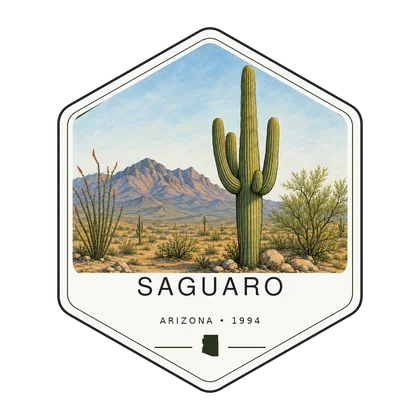
Log the visit, keep your story, and watch the map of all sixty-four fill in behind you. Every visit has a keepsake worth holding.
See the full map and track every park you have visited.
View the map → PlanTurn Saguaro into a road trip with a custom, day-by-day itinerary.
Start planning → Go deeperWoodpeckers drill in first. The smallest owl on Earth moves in after.
Read it → New · NearbyThe 64th national park, a sky island of rhyolite pinnacles in southeastern Arizona.
Open the guide →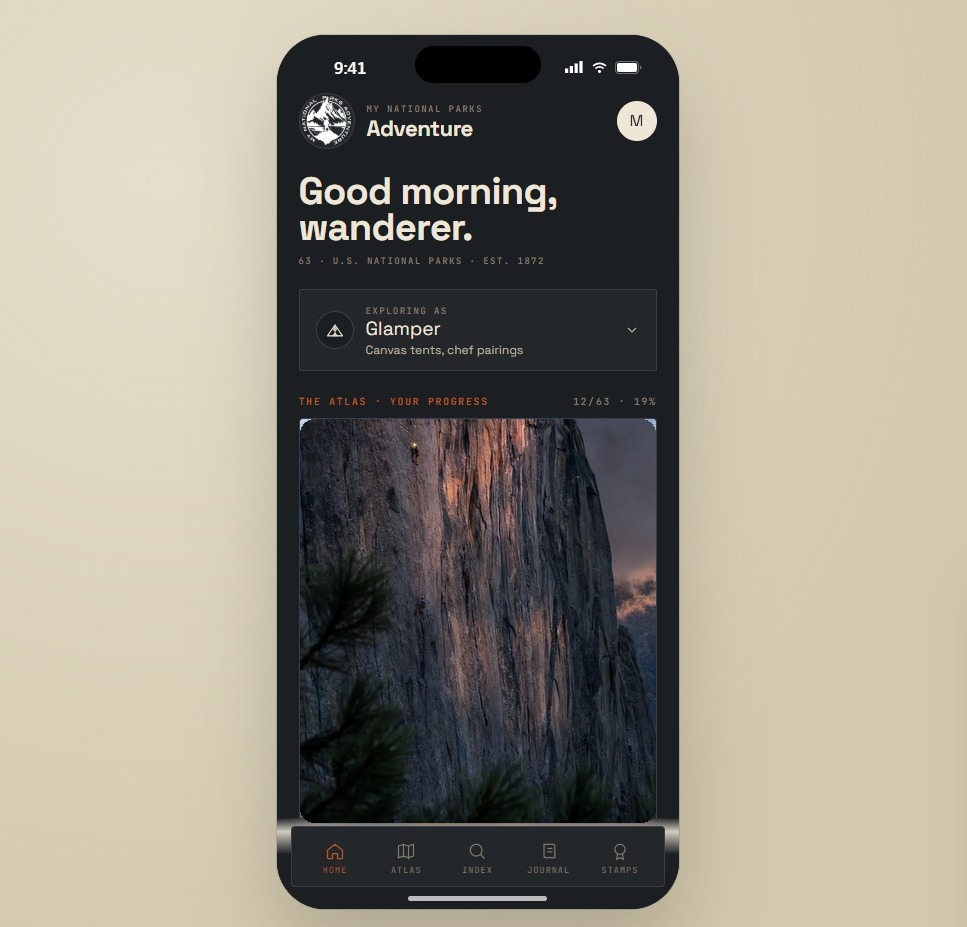
Offline maps, your passport, and every park in your pocket on the trail.
Join the waitlist →
The printed edition, part atlas, part journal, one story per park.
Notify me →Park-guide posters, enamel stamps, and the passport book to fill in.
Visit the shop →Field Notes
The parks do not perform for anyone. They stood here before the road, and they will stand here after it.