Dune Succession Trail
Easy–Mod
1 mi+150 ft~45 min
A short but genuinely strenuous loop with wooden stairs through beach, dune, and forest habitat at West Beach. No permit.
 National
Indiana · Park 48 / 64
Fifteen miles of Lake Michigan shoreline, ranked among the most biodiverse national parks despite sitting between two steel towns.
Indiana Dunes protects fifteen miles of Lake Michigan shoreline squeezed between the industrial cities of Gary and Michigan City, an unlikely setting for a national park that also happens to rank among the most biologically diverse in the entire system. Wind and waves have shaped this shoreline for millennia, creating a compressed sequence of habitats, from open beach to dune to woodland to wetland, that can shift dramatically within a few hundred feet of walking.
Mount Baldy, a 126-foot dune on the park's eastern end, is slowly moving inland and burying the forest behind it, a process visible enough that visitors are no longer allowed to climb the dune itself due to a partially collapsed sand pocket. The park was upgraded from a national lakeshore to a full national park only in 2019, a designation change that surprised even some longtime Indiana residents who hadn't fully registered a national park existed in their own backyard.
Come for the dunes and the lake. Stay for the fact that a genuinely wild ecosystem survives this close to major industry. Read the story, trust the live data above for what is open today, and when you leave, mark it visited.

Indiana Dunes National Park was an awesome surprise and proof you don't have to head out west to find great scenery and outdoor adventure.Adapted from visitor accounts of Indiana Dunes' Lake Michigan shoreline
Six ways to spend your time, from a swim in Lake Michigan to a dune that's quietly swallowing the forest behind it.
The park's most developed beach, with a bathhouse, lifeguards in summer, and the Dune Succession Trail nearby.
The signature beachA 126-foot moving dune, viewable from the parking lot and beach access trail; climbing the dune itself is no longer permitted.
Everyone · 40 min beach walkA short but genuinely strenuous trail through dune, forest, and open lake views in under a mile.
Half day · some stairsExhibits on the park's unusual biodiversity and its history as an early conservation battleground.
Everyone · 30 minOne of the most significant birding locations in the Midwest, with hundreds of species recorded across the park's habitats.
Birders · any seasonA separately administered state park sits inside the national park's boundary, with its own entrance fee and its own set of dune trails.
Half day · separate feeAnswer a few questions right here. We'll map your day, stop by stop, with a route, timings, weather, and a packing checklist grounded in real park data. No account, no leaving this page.
⚡ In a hurry? Adventure Light 5 questions →Every trail rated honestly, with distance, climb, and a note on which sections cross into the separately run state park.
A short but genuinely strenuous loop with wooden stairs through beach, dune, and forest habitat at West Beach. No permit.
A walk from the parking area to the beach beneath Mount Baldy; the dune itself is closed to climbing. No permit.
A loop through wetland and forest habitat named for the ecologist whose research here helped found the field of plant ecology. No permit.
A flat trail through restored wetland habitat, a good birding spot in any season. No permit.
A quieter, forested trail along the Little Calumet River, away from the beach crowds. No permit.
A steep climb over three named dunes inside the separately administered state park, popular as a fitness challenge.
No permit for national park trails · Indiana Dunes State Park inside the boundary charges its own separate entrance fee · Mount Baldy's dune itself is closed to climbing
Tap any animal to learn its story. Soon, the app will let you log what you spot and keep a life list for every park.
An endangered butterfly dependent on wild lupine, found in the park's dune and oak savanna habitat.
The park sits along a significant migratory route, making it one of the most important birding locations in the Midwest.
Common throughout the park's dune and forest edges, occasionally visible at dawn and dusk.
A threatened species found in the park's wetlands, including the Great Marsh restoration area.
Common throughout the park's forested and wetland habitats.
The park's Lake Michigan shoreline supports a range of native and introduced fish species, a draw for shoreline anglers.
Common throughout the park's wooded areas, larger and more reddish than the more familiar gray squirrel.
The sole food source for Karner blue butterfly caterpillars, found in the park's dune and savanna habitat.
A cactus species found growing in the dunes here, an unexpected desert-adapted plant this far north and east.
The park protects one of the largest remaining black oak savannas in the country, a rare and increasingly uncommon ecosystem.
Common on the active dunes, its extensive root system helping stabilize the shifting sand.
Found on the park's older, more stable dunes, tolerant of the sandy, nutrient-poor soil.
Found in the park's remaining prairie fragments, a tall purple-spiked wildflower blooming in late summer.
Indiana Dunes ranks among the most biologically diverse national parks in the entire system, despite its small size and industrial surroundings.
Mount Baldy is a living, moving dune, slowly advancing inland and burying the forest behind it; climbing the dune itself is no longer permitted.
The park became a full national park only in 2019, upgraded from a national lakeshore designation held since 1966.
Research on plant succession conducted here by ecologist Henry Cowles in the early 1900s helped found the field of plant ecology as a scientific discipline.
The questions people actually ask, answered from the park’s own current guidance. Fees and permit rules change every year, so each answer links back to the National Park Service page it came from.
No, Indiana Dunes National Park has no entrance fee, unlike most national parks. You will pay separately for things like camping at Dunewood Campground or reserving a picnic shelter at West Beach or Bailly/Chellberg through recreation.gov. Source: NPS.gov
Most of the park's public areas are open daily from 6 a.m. to 11 p.m., though Kemil Beach stays open 24 hours and Porter Beach and West Beach close earlier at 9 p.m. Dunewood Campground is seasonal, running from April 1 through November 1, but the beaches and trails themselves are accessible year-round including in winter. Source: NPS.gov
Swimming comes with real risk here because rip currents are, in the park's own words, the most significant drowning threat on Lake Michigan. If you get caught in one, swim parallel to shore rather than fighting it until the pull lets up. Lifeguards are only on duty at West Beach, from the Friday of Memorial Day weekend through Labor Day, 10 a.m. to 6 p.m., and the park also monitors beaches for bacteria, closing the water to swimming when levels are posted as unsafe. Source: NPS.gov
Stories, guides, and hard-won tips from the trail. The full Indiana Dunes deep dive lives on the blog.
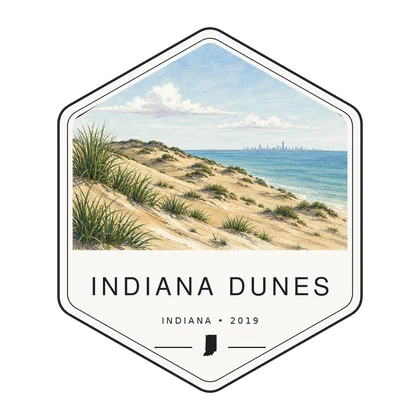
Log the visit, keep your story, and watch the map of all sixty-four fill in behind you. Every visit has a keepsake worth holding.
Another accessible, near-urban park proving you don't need to go remote for real wilderness.
Open Park 40 → The collectionSee the full map and track every park you have visited.
View the map → PlanTurn Indiana Dunes into a trip with a custom, day-by-day itinerary.
Start planning → Go deeperThe trail where modern ecology was born, a fur trader's crossroads, and Chicago World's Fair houses that floated across Lake Michigan.
Read it →
Offline maps, your passport, and every park in your pocket on the trail.
Join the waitlist →
The printed edition, part atlas, part journal, one story per park.
Notify me →Park-guide posters, enamel stamps, and the passport book to fill in.
Visit the shop →Field Notes
The parks do not perform for anyone. They stood here before the road, and they will stand here after it.