Kīlauea Iki Trail
Moderate
4 mi+400 ft~2.5 hr
A loop descending into a crater that held an active lava lake in 1959, crossing its now-solidified floor. No permit.
 National
Hawaii · Park 54 / 64
Home to Kilauea, one of the most active volcanoes on Earth, currently in the middle of an ongoing episodic eruption that began in December 2024.
Kīlauea, one of the most active volcanoes on Earth, has been in an episodic eruption since December 23, 2024, with lava fountaining episodes in Halemaʻumaʻu crater separated by pauses that can last anywhere from hours to several weeks. As of this writing the eruption has passed its fiftieth episode, and forecasters use summit inflation data to predict roughly when the next one will begin, though the timing always carries real uncertainty. Whether you'll see active lava fountains during your visit depends entirely on where the eruption sits in its cycle on the day you arrive.
Even without an active episode underway, the park delivers: Crater Rim Drive circles the summit past steam vents, sulfur banks, and the Nāhuku lava tube, a walkable tunnel formed by an actual flowing lava river centuries ago. The Kīlauea Iki Trail descends into a crater that was a churning lava lake in 1959, now a solidified black floor you can walk directly across.
Come and check the current eruption status before you go, since it genuinely changes what kind of visit this will be. Read the story, follow the safety guidance around tephra and volcanic gas, and when you leave, mark it visited.

It's incredible to experience live volcanic activity, watching lava fountains rise hundreds of feet above the crater rim.Adapted from visitor accounts of witnessing an active Kilauea eruption episode
Six ways to spend your time, with a clear note on which experiences depend on the volcano's current mood.
Multiple viewpoints along Crater Rim Drive offer views into the caldera, spectacular during an active fountaining episode, still worthwhile between them.
The signature view · check USGS status firstA short walk through a real lava tube formed by a flowing river of molten rock centuries ago, partially lit inside.
Everyone · 30 minA loop descending into a crater that was an active lava lake in 1959, now a solidified black crater floor to walk across.
Half day · some elevationA dramatic descent from the summit to the coast, passing multiple craters and ending at a sea arch carved by ocean waves.
Half day · full scenic driveExhibits on volcanic activity and current safety guidance; check here before setting out to any overlook.
Everyone · essential first stopAreas where volcanic steam and gas rise naturally from the ground, visible without any active eruption underway.
Everyone · 20 minAnswer a few questions right here. We'll map your day, stop by stop, with a route, timings, weather, and a packing checklist grounded in real park data. No account, no leaving this page.
⚡ In a hurry? Adventure Light 5 questions →Every trail rated honestly, with a clear note that current eruption status can change access to some areas at any time.
A loop descending into a crater that held an active lava lake in 1959, crossing its now-solidified floor. No permit.
A short walk through a real lava tube, partially lit and sometimes affected by maintenance closures. No permit.
A trail circling the summit caldera, walkable in sections passing multiple overlooks. Some sections close during active eruptions.
A boardwalk through an area of natural steam and sulfur gas venting from the ground. No permit.
A scenic drive passing multiple craters, ending at the Holei Sea Arch. No permit.
A remote, high-altitude backcountry route to the summit of Mauna Loa, one of the most demanding trails in the park system.
No permit for most day hikes · free backcountry permits for overnight camping and the Mauna Loa summit route · check current eruption status via USGS and NPS before visiting, as closures can change quickly
Tap any animal to learn its story. Soon, the app will let you log what you spot and keep a life list for every park.
Hawaii's state bird, recovering here after nearly going extinct, occasionally seen along park roads and near the visitor center.
A native hawk found only in the Hawaiian Islands, occasionally visible soaring over the park's forested areas.
A tiny native spider with a face-like marking, found across several islands including the Big Island's forests.
The only native land mammal in Hawaii, found in the park's forested areas, mostly active at dusk and night.
One of only two native Hawaiian butterfly species, occasionally seen in the park's lower-elevation forest.
A bright red native Hawaiian honeycreeper found in the park's native forest, feeding primarily on 'ōhi'a lehua blossoms.
An introduced species causing damage to native forest understory; the park works actively to control and exclude them from sensitive areas.
Often the very first tree to grow on fresh lava flows, a keystone native species throughout the park's forest.
Common in the park's rainforest zones, especially visible along the Kīlauea Iki Trail's forested sections.
One of the first plants to establish on new lava flows, alongside 'ōhi'a, beginning the process of forest recovery.
Related to the famous Haleakalā silversword, several native volcanic-adapted plant species grow in the park's harsher terrain.
A culturally significant native Hawaiian hardwood tree found in parts of the park's forest.
Thin strands of volcanic glass formed during lava fountaining, often mistaken for plant material; can cause skin and eye irritation if touched.
Kīlauea has been in an ongoing episodic eruption since December 23, 2024, with more than 50 separate lava fountaining episodes recorded as of mid-2026.
Individual eruption episodes typically last hours to a few days, separated by pauses that can run from under a day to several weeks.
The Nāhuku lava tube was formed by an actual flowing river of molten lava centuries ago, now cooled into a walkable tunnel.
Mauna Loa, also within the park, is the largest active volcano on Earth by volume, though it is not currently erupting.
The questions people actually ask, answered from the park’s own current guidance. Fees and permit rules change every year, so each answer links back to the National Park Service page it came from.
A private vehicle pass is $30, a motorcycle pass is $25, and it's $15 per person on foot or by bike (16 and older; under 16 is free). Passes are good for 7 days, and the park is card-only, no cash accepted. Source: NPS.gov
No, a typical visit only requires the standard entrance fee at the gate or a valid pass, with no timed-entry or reservation system for general admission. A special use permit is only needed for commercial activity like filming or weddings, not for regular sightseeing. Source: NPS.gov
The park doesn't have the seasonal snow closures you'd see at a mainland park, but a two-year construction project is repairing and removing damaged buildings and infrastructure near the summit, so expect intermittent closures and delays there into 2027. The park also posts periodic air quality alerts for volcanic gas, so check conditions frequently during your visit. Source: NPS.gov
Yes. As of a July 22, 2026 park update, Kilauea continues to erupt intermittently from Halemaʻumaʻu crater, with more than 50 separate eruptive episodes since December 2024. The eruption zone itself is closed to visitors because of volcanic gas, unstable cliff edges, and falling tephra, but you can safely view the activity from overlooks along Crater Rim Drive such as Uēkahuna, the Kīlauea Overlook at the Steam Vents, Kūpinaʻi Pali, and Keanakākoʻi. Source: NPS.gov
Stories, guides, and hard-won tips from the trail. The full Hawaiʻi Volcanoes deep dive lives on the blog.
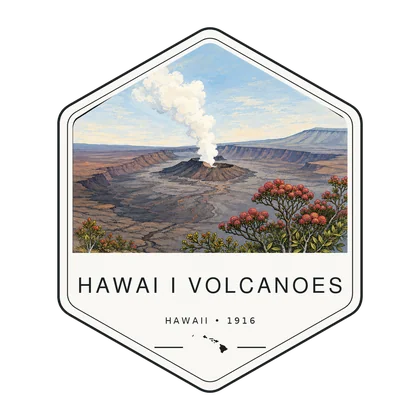
Log the visit, keep your story, and watch the map of all sixty-four fill in behind you. Every visit has a keepsake worth holding.
A short flight to Maui: another Hawaiian volcano, dormant instead of active, with its own crowd of sunrise seekers.
Open Park 53 → The collectionSee the full map and track every park you have visited.
View the map → PlanTurn Hawaiʻi Volcanoes into a trip with a custom, day-by-day itinerary.
Start planning → Go deeperIn 1959, Kilauea Iki was a 414-foot-deep lake of molten lava with fountains taller than the Empire State Building. Today you can walk across it.
Read it →
Offline maps, your passport, and every park in your pocket on the trail.
Join the waitlist →
The printed edition, part atlas, part journal, one story per park.
Notify me →Park-guide posters, enamel stamps, and the passport book to fill in.
Visit the shop →Field Notes
The parks do not perform for anyone. They stood here before the road, and they will stand here after it.