
At 8:08 on the evening of November 14, 1959, the ground at Kilauea's summit split open and started throwing lava nearly two thousand feet into the Hawaiian night sky, taller than any building on Earth. By the time it stopped, five weeks later, the crater below held a lake of molten rock 414 feet deep. Today, a maintained trail crosses that same crater floor, and hikers walk across it in sneakers.
What makes Kilauea Iki worth understanding isn't just the eruption itself. It's how long the ground kept the secret afterward: the lake didn't fully finish cooling to solid rock until sometime in the mid-1990s, more than three decades after the last fountain went dark.
Five Weeks, Seventeen Pulses
The Kilauea Iki eruption began on November 14, 1959, and didn't finally stop until December 20, unfolding across seventeen distinct episodes rather than one continuous event. Between pulses, the fountaining would pause, sometimes for hours, sometimes for a day or more, before restarting and adding another layer of fresh lava to the crater floor below. Each episode behaved slightly differently, some producing modest fountains, others building toward something far more dramatic.
By the time the eruption finally exhausted itself, the crater had gone from an empty pit to a lake of lava with a genuine, measurable volume: 58 million cubic yards at its peak, reached on December 11.
Nineteen Hundred Feet
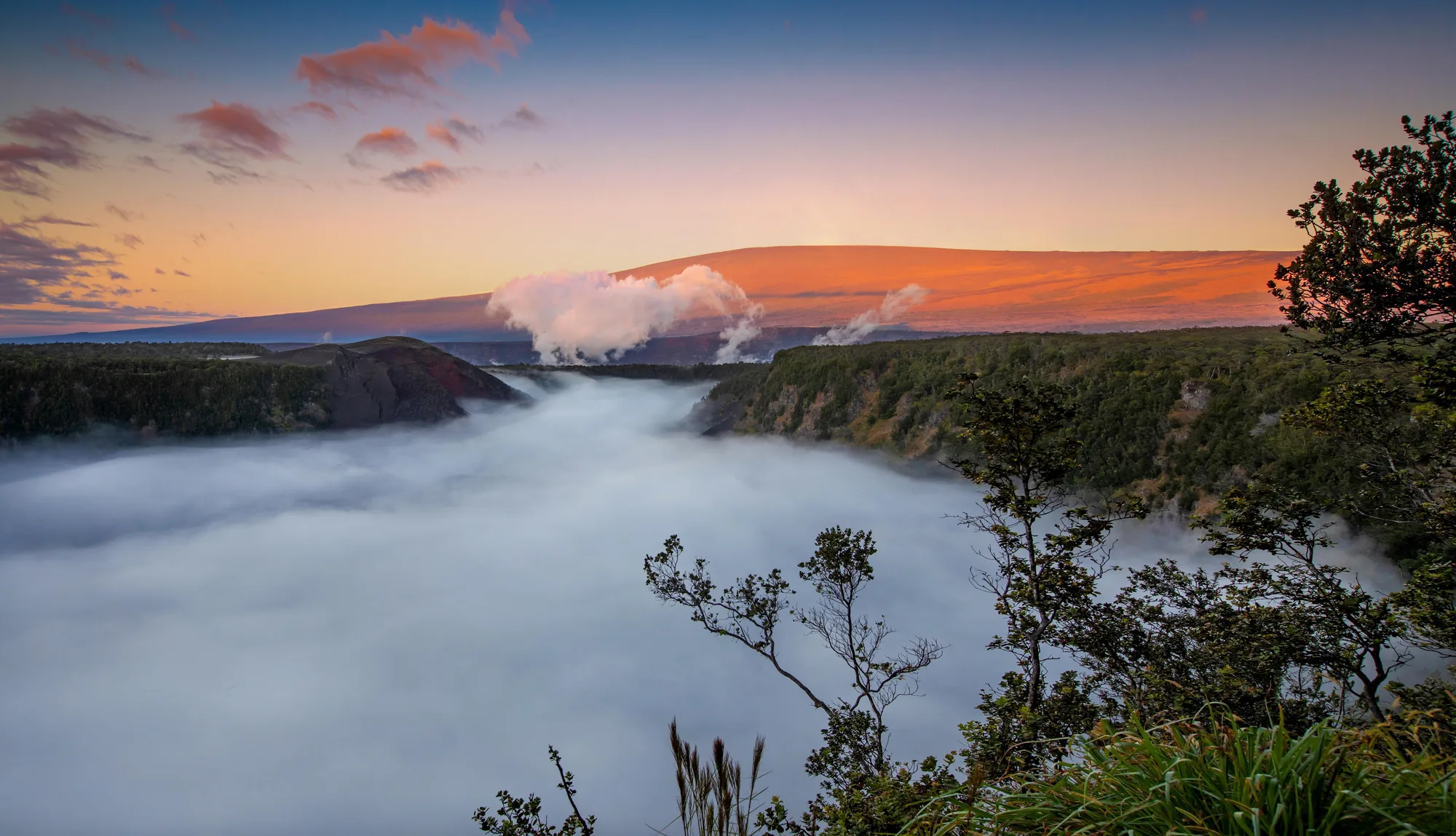
The eruption's early fountains reached a relatively modest 100 feet. That changed fast. By the fifteenth episode, a single fountain shot lava nearly 1,900 feet into the air, roughly four hundred feet taller than the Empire State Building, and it remains one of the highest lava fountains ever recorded anywhere in the world. Molten rock falling from that height built up the surrounding cinder cone quickly, while the lake below kept climbing with every new episode.
Walk the Crater Floor
The Kilauea Iki trail is about four miles round trip. The trip planner fits it alongside Nahuku and the Crater Rim overlooks in one day.
Open the Trip PlannerMolten for Thirty Years
The lava lake reached its greatest depth, 414 feet, on December 11, 1959, though a 1988 drilling project found the true depth had settled to about 443 feet as the crater floor subsided into the magma chamber below. The surface crusted over in a matter of months, solid enough to walk on not long after the eruption ended, but that crust was deceptive. A drilling survey in 1968, nearly a decade after the fountains stopped, still found molten rock at 60 meters down. The lake as a whole didn't finish solidifying all the way through until sometime in the mid-1990s, more than thirty years after anyone last saw it erupt.
- Eruption dates NOV 14 – DEC 20, 1959
- Tallest fountain ~1,900 FT
- Max lake depth 414 FT (1959)
- Fully solidified MID-1990s
The Kilauea Iki Trail
The full Kilauea Iki loop runs about four miles, descending through native ohia and fern rainforest before crossing roughly two and a half miles directly over the crater floor itself, a two-to-three-hour hike for most visitors. Underfoot for that stretch is the same lake that once glowed orange, now a cracked, hardened plain of dark rock, still steaming faintly from vents in places even decades on. It's one of the few places in the National Park System where a maintained trail runs directly across the surface of a specific, dated volcanic event rather than around it.
Facts and figures checked against USGS Hawaiian Volcano Observatory published records of the 1959 Kilauea Iki eruption and NPS.gov's Kilauea Iki Trail materials.
The fountain that reached 1,900 feet in November 1959 lasted only minutes before the episode ended. What it left behind took over thirty years to finish cooling, and today a rainforest trail crosses it in under three hours, no different underfoot than any other rock, until you remember what it was doing the last time anyone stood this close to it.