
On August 25, 2006, naturalists Chris Atkins and Michael Taylor were bushwhacking through a remote stretch of Redwood National Park when they found a coast redwood taller than anything else alive on Earth. They named it Hyperion. It stands roughly 380 feet, a good deal shorter than a lot of people assume the tallest tree on the planet ought to be, and that shortfall turns out to be the interesting part of the story.
No coast redwood, anywhere, has ever been reliably measured taller than about 380 to 400 feet, despite species that can live over a thousand years and keep growing the whole time. Something is stopping them, and it isn't lack of time.
You Cannot Go See Hyperion
Hyperion sits in a location the National Park Service has never published, and since July 2022 it's been formally closed to the public after visitor foot traffic trampled the understory and damaged fern cover growing at its base. Off-trail bushwhacking to reach it is illegal now, not just discouraged: trespassing into the closure carries up to six months in jail and a $5,000 fine. The tree is estimated at 600 to 800 years old, meaning it started as a seedling sometime between roughly 1200 and 1400 CE, centuries before European contact with California, and has spent every year since then adding height a few inches at a time.
The Tree Doesn't Pump. It Sucks.
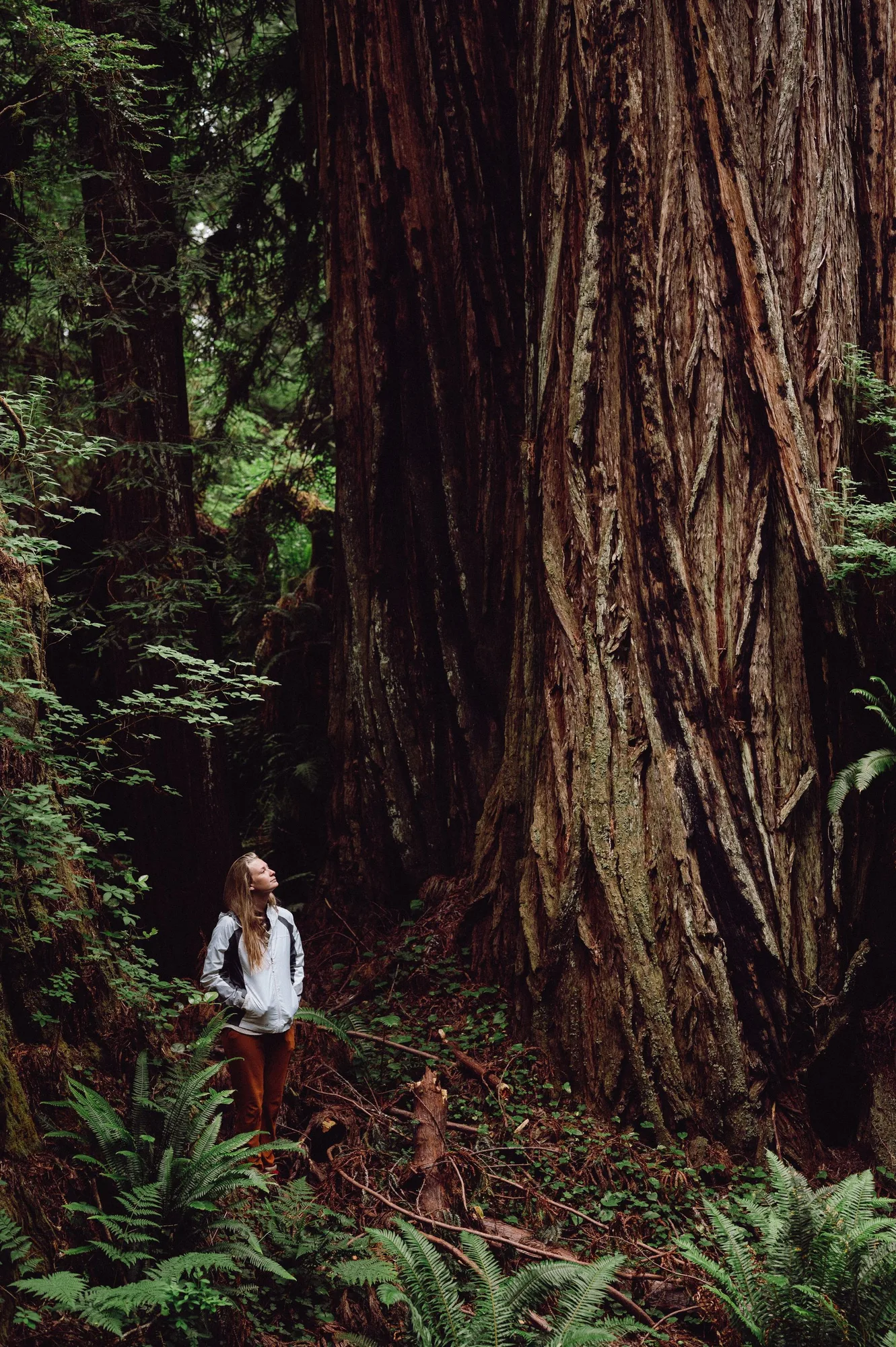
According to the National Park Service, a redwood lifts water from its roots to its crown through transpiration suction: water evaporating out of tiny pores in the leaves at the very top of the tree creates enough pulling force to draw a continuous column of water upward through the trunk's internal plumbing, the same way sucking on a straw pulls liquid up from the bottom of a glass. No pump does the work. The evaporation itself is the engine, running continuously as long as the sun is up. At the same time, the tree hedges against how hard that lift gets the higher it climbs: leaves throughout the canopy, including hundreds of feet up, absorb moisture directly out of coastal fog, and the National Park Service states that fog drip supplies nearly 40 percent of a redwood's water during the dry summer months. That's water the tree never has to lift from the ground at all.
Plan Your Redwood Visit
The tallest trees you can actually walk among, without a closure or a bushwhack, are in Tall Trees Grove and along the Redwood Creek Trail. The trip planner can help you build a day around them.
Open the Trip PlannerGravity Wins Eventually
Pulling water upward by suction works, but it costs more tension the higher the column climbs, and researchers studying coast redwoods believe that somewhere in the range of 380 to 400 feet, the physics starts working against the tree. Past that height, the pulling force needed to keep drawing water upward approaches the point where tiny air bubbles can form inside the water column itself, a failure called cavitation that would block the flow entirely at whatever point it occurs. That's the leading explanation for why no redwood, coast sequoia or otherwise, has ever been measured meaningfully past 400 feet despite individual trees living well over a thousand years with plenty of time to keep climbing. It isn't a hard, universally agreed-upon number, and it isn't something the National Park Service states outright on its own pages, but it lines up with the fact that Hyperion, found in 2006 and still the tallest known living tree on Earth two decades later, tops out almost exactly where the physics says it should.
- Height ~380 FT
- Estimated age 600-800 YRS
- Discovered AUG 25, 2006
- Public access CLOSED SINCE JULY 2022
No Taproot. Just Neighbors.
A 380-foot column of wood ought to be top-heavy enough to topple in the first real coastal storm, and coast redwoods don't fight that with a deep taproot the way a person might expect. The National Park Service states that redwood roots typically descend only 10 to 13 feet before turning and spreading horizontally, reaching 60 to 80 feet out from the trunk, and along the way they intertwine directly with the root systems of neighboring redwoods. A single tree isn't holding itself up. An entire grove is holding each other up, underground, through physically linked root networks that turn what looks like a forest of individuals into something closer to one connected structure. Trunks at the base of a mature tree can exceed 20 feet in diameter, wide enough that the grip of a dozen intertwined neighbors matters more to staying upright than anything happening straight down.
Hyperion's height, age, discovery date, and closure details checked against the National Park Service's own Redwood National and State Parks pages and current public reporting on the 2022 closure. The transpiration and fog-drip mechanics, and the root-architecture figures, are stated directly by the National Park Service's "Coast Redwood" species article. The roughly 380-to-400-foot cavitation ceiling is a widely discussed hypothesis among researchers studying redwood physiology, not a figure the National Park Service states outright on its own pages, so it's presented here as what researchers believe rather than settled fact.
Hyperion is still out there, closed off, still adding height in inches nobody will measure up close again anytime soon. Whatever ceiling the physics actually enforces, this tree has spent six to eight centuries climbing toward it, and it may already have found it. Every other coast redwood alive today is running the same experiment, one growing season at a time, against the same limit written into how water and gravity work.