In the winter of 1922, Denali's first superintendent needed a way to move rangers and gear across a park with no roads, in temperatures that would have seized up any engine of the era even if one could have been hauled in. He bought seven dogs, at forty-five dollars apiece, and put them to work patrolling for poachers. A century later, the kennel he started is still standing, still breeding its own dogs, and still sending rangers into the backcountry behind a team every winter. No other unit in the entire National Park System keeps a working kennel like it.
Plenty of parks have a historic building, a preserved cabin, a ranger station frozen at some earlier decade for visitors to walk through. Denali has a program that has never stopped operating, doing a version of the same job, on the same land, for over a hundred years running.
More Than He Needed a Truck
Harry Karstens became the park's first superintendent in 1921, a year after Congress created what was then called Mount McKinley National Park. He wasn't a stranger to the mountain at the center of it. Eight years earlier he'd been on the 1913 expedition that made the first confirmed summit, climbing alongside Hudson Stuck and a young Koyukon Athabascan dog musher named Walter Harper, who reached the true summit first. Karstens knew exactly what he was now responsible for protecting: several million acres of subarctic wilderness, no roads beyond what would eventually become a single park road, and winters that made a motor vehicle useless even if the park had owned one.
So in 1922 he bought seven sled dogs, at forty-five dollars each, which the Park Service today calculates at something over seven hundred ninety dollars a dog once adjusted for a century of inflation. The assignment was direct: patrol the boundary for poachers, and move people and supplies across a park that offered no other way to do either once the snow came. It worked. The kennel grew fast enough that within eight years it held more than forty dogs, and by 1936 the count stood at fifty adults and fourteen pups underfoot.
The program never really stopped after that. It survived the park's 1980 renaming from Mount McKinley to Denali, it survived the near-total disappearance of the poaching problem that justified buying the first seven dogs, and in 2022 it quietly passed its hundredth year of continuous operation: the same institution, doing an evolving version of the same job.
One Litter at a Time
The dogs on the yard today are Alaskan huskies, bred specifically for freight work rather than speed racing. Sixty to ninety pounds, compact feet, a dense double coat, and a tail full enough to wrap over the nose and mouth in a whiteout. Any other breed, one park staffer has put it, would be cruel to run in conditions like these.
The park keeps a working yard of roughly thirty to thirty-five dogs, enough to field three to five active teams through a winter, and it breeds its own replacements rather than buying them in from outside. The current bloodline traces back to a Greenland Eskimo dog named Susie, brought into the program in 1972, and the kennel still trades breeding stock today with six to ten other Alaska freight-hauling kennels to keep the gene pool from narrowing. Each working dog covers roughly fifteen hundred miles over the course of a season and typically retires around age nine, having spent most of its working life on terrain with no trail markers, because there are no trails.
- Born MARCH 30, 2026
- Names SEQUOIA, MAMMOTH, RAINIER, TETON, MESA
- Theme NATIONAL PARKS, FOR AMERICA'S 250TH
- Dam · Sire SPARK (2023 "FIRE" LITTER) · TRAPPER
Litters get a theme every year, not just a name. Past years have run Alaska Youth, Little Switzerland, 9/11 Search and Rescue, and a Fire litter before this year's national-parks theme, each one tied to something the park or the country happened to be marking that season. It reads as a small tradition on its own, but it has been kept up every year since the breeding program formalized, and a small tradition repeated for decades starts to look like an institution.
Plan Your Denali Visit
Time a trip around the summer kennel demonstrations, or any of Denali's shuttle-bus routes, with a free custom itinerary.
Open the Trip PlannerA Job No Engine Has Replaced
The practical case for dog teams is written straight into the map. Denali holds more than two million acres of federally designated Wilderness, and under the terms of that designation, motorized vehicles are restricted inside it. A snowmobile isn't a clever workaround for a park without roads, it's precisely the thing the law was written to keep out. A dog team, quietly, is not.
What the patrol work actually looks like has changed a great deal since 1922. The poaching problem that justified buying the first seven dogs is a much smaller part of the job today. Winter rangers on dog sleds now mostly contact backcountry recreationists, check on trail and route conditions, and offer assistance in places a truck could never reach even if the law allowed one. They also haul gear for the park's own science, which is where the modern job gets genuinely interesting: hauling researchers and equipment out to remote vegetation plots near Wonder Lake to measure snow depth by hand, ground-truthing what a satellite says about snow cover against what is actually on the ground, and supporting long-term climate and vegetation monitoring sites that in some cases stretch back to the 1950s.
That is the quiet argument for keeping a hundred-year-old program running. It isn't nostalgia, or at least not only nostalgia. A wilderness this size, closed to motors by its own legal designation, still needs some way to move people and gear through it in January, and a century of trying has not turned up anything that beats a team of dogs bred for exactly this.
The Most Visited Overlook That Isn't One
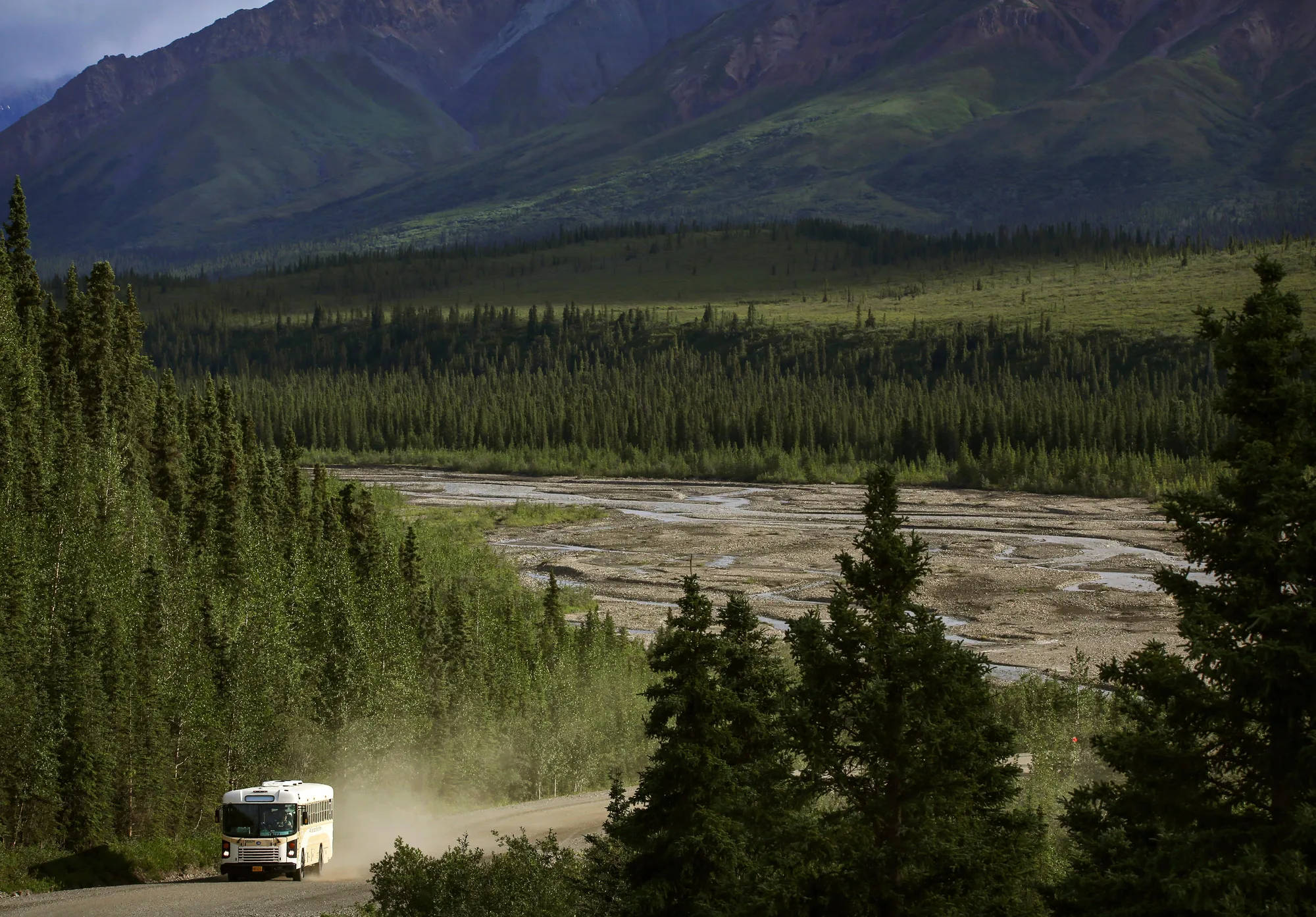
The kennels sit about three miles into the park, close to Park Headquarters. From the Denali Visitor Center it's roughly a two-mile hike, mostly uphill, or a free shuttle bus that runs during the summer season, May 15 through mid-September, dropping visitors within a short walk of the dog yard. Free public demonstrations run daily through that same window, 9:30 in the morning to 4:30 in the afternoon. In fall and winter the kennels open only on Saturdays and Sundays, one to four in the afternoon, and demonstrations aren't guaranteed outside the summer schedule.
What visitors are watching is a working animal doing a version of the same job Karstens's first seven dogs were bought to do in 1922: moving through a wilderness with no roads, on a team that a century of engineering still hasn't managed to replace, wearing a name today that's just as likely to belong to a national park as to a poacher's trail.
Facts and figures checked against the National Park Service's own Denali kennels history page, its 2022 kennels centennial article, and its current kennel-visiting and breeding-program pages. The kennel building's exact construction year is reported inconsistently across secondary sources (1926 versus 1929); this piece states only the well-corroborated 1922 program founding date and avoids the disputed building-construction date. Litter and population figures are the most recent NPS-published numbers as of this writing.
Karstens never called it a tourist attraction. He called it transportation, because in 1922 it was the only kind that worked past the first few miles of a park with no roads. A century on, the dogs are better bred and the puppies are named for national parks instead of nothing in particular, but the job itself hasn't changed: move through a wilderness the law says no engine may enter, in weather that would stop one anyway.