A farmer named Frank Lauzon dreamed about moving a river through solid rock. Eight years later, a crew of five hundred men had actually done it.
The Valley Next Door Had Land, Sun, and Nowhere Near Enough Water
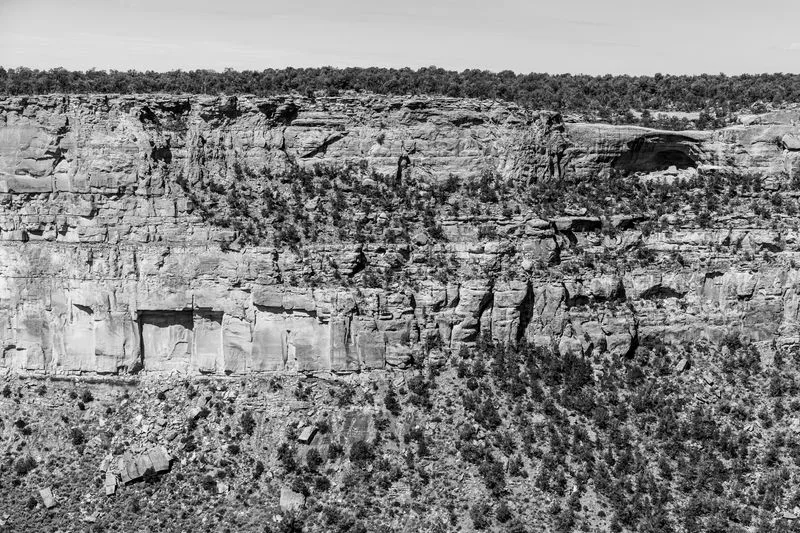
The Uncompahgre Valley, just south of the Black Canyon, had good soil and enough sun to grow almost anything. What it didn't have was a reliable river. The Uncompahgre River that ran through it could theoretically water 175,000 acres, but in practice it couldn't be trusted, and by 1890 fewer than 30,000 acres were actually under cultivation. Meanwhile, on the other side of a canyon nobody had ever fully explored, the Gunnison River carried far more water than the valley needed. It just happened to be running through one of the most inaccessible gorges in Colorado to get there.
A local farmer and former miner named Frank Lauzon is credited with the idea that stuck: dig a tunnel straight through the mesa separating the two rivers and let gravity do the rest. In 1900, an exploratory party attempted to survey a route through the canyon itself to test the idea. In 1901, the state of Colorado put up $25,000 to start digging. It bought about 900 feet of tunnel before the money ran out. The project looked, for a while, like exactly what it sounds like: a good idea nobody could actually afford to finish. That changed in 1902, when Congress passed the Reclamation Act and gave the federal government a mechanism to fund exactly this kind of project. By 1903, the newly formed Bureau of Reclamation had adopted it as the Uncompahgre Project. Real construction began in 1905.
- Land the valley hoped to irrigate 175,000 ACRES
- Land actually irrigated by 1890 <30,000 ACRES
- State funding, 1901 $25,000 · ~900 FT DUG
- Federal takeover 1902 RECLAMATION ACT · 1903 BUREAU PROJECT
Visit East Portal
The tunnel's original construction site sits inside the park boundary, reachable by a steep, narrow road down to the river.
Open the Trip PlannerBuilding It Meant Working Inside a Canyon That Fought Back
The canyon didn't make it easy. Crews first had to build a road down to the river at a 30 percent grade, cut into walls that rose 2,000 feet above them, just to reach the point where digging could start. Underground, the work got worse: seeping water, pockets of poisonous gas, punishing heat, and fractured fault zones that could give way without warning. Cave-ins killed six workers. A single explosion and the smoke that followed it killed twelve more. A falling boulder killed one more after that, nineteen deaths in total by the time the tunnel was finished. Turnover was constant. Even with good pay by the standards of the day, few men stayed more than a few weeks. At peak, the Bureau of Reclamation employed as many as 500 workers, housed in temporary settlements called Lujane and East Portal that had their own schools, hospitals, and dining halls, small towns built to support a hole in the ground.
The two ends of the tunnel, dug from opposite directions and guided by careful geometric survey work rather than any way to see through the mesa between them, met underground on July 6, 1909. When they finished the tunnel measured 5.8 miles long, 11 feet wide, and 12 feet high, the longest irrigation tunnel in the world at the time it opened. The official dedication came on September 23, 1909, with President William Howard Taft, on a Western tour, presiding in person. Montrose threw a parade and built a two-story memorial arch across Main Street for the occasion. Taft, addressing the crowd, called the region the "incomparable valley with the unpronounceable name," a line that made it into the local papers and stuck.
- Length 5.8 MILES · 11 FT WIDE · 12 FT HIGH
- Holed through JULY 6, 1909
- Dedicated SEPT 23, 1909 · PRESIDENT TAFT
- Deaths during construction 19 (CAVE-INS, EXPLOSION/SMOKE, ROCKFALL)
Construction timeline, casualty figures, tunnel dimensions, and the Taft dedication details checked against the National Park Service's official history of the Gunnison Tunnel and its East Portal site. Uncompahgre Valley irrigation figures checked against the same NPS source.
The tunnel is still working. Water still moves from the Gunnison River, through that 5.8-mile bore, and into the Uncompahgre Valley, irrigating roughly 76,300 acres today, up from the 37,000 the valley managed when the tunnel was new. Since the 1960s, some of that irrigated land has grown Moravian malting barley for Coors, a beer brewed with water that a farmer once dreamed about pulling through solid rock and nineteen men died getting there. The tunnel earned National Historic Civil Engineering Landmark status and a spot on the National Register of Historic Places in 1979. It's easy to drive past East Portal today and see only a quiet river access point. What's actually there is the reason the valley next door exists in its current form at all.