
Before it was anyone's postcard, the ranchers who worked this stretch of Utah desert on horseback looked up at a 52-foot arch of red sandstone and called it "the Chaps." Some called it something cruder: "the Schoolmarm's Bloomers." Neither name made it into the guidebooks.
What did make it into the guidebooks came from a man on a government-funded expedition who spent a winter cataloging the strange rock shapes of eastern Utah and decided this one deserved better. His replacement name stuck so completely that most visitors today have no idea the arch was almost remembered as underwear.
What the Cowboys Called It
Frank Beckwith led the Arches National Monument Scientific Expedition through the winter of 1933 and 1934, tasked with formally documenting the monument's rock formations for the first time. He found that local ranchers already had names for most of them, usually blunt and occasionally profane. The arch that would become the park's signature image was known locally as "the Chaps," for its rough resemblance to a pair of leather leggings, or less charitably as "the Schoolmarm's Bloomers." Beckwith, apparently unimpressed by either option, renamed it Delicate Arch, a name meant to describe the thin, curved ribbon of stone itself rather than anything a cowboy might have been picturing.
From Nameless Rock to State Symbol
The arch stands 52 feet tall, carved from Entrada sandstone the same slow way every arch in the park was made: a fin of rock exposed to wind and water until the softer layers gave way and left the harder shell standing on its own. What's unusual isn't the geology, it's what happened to the image afterward. Delicate Arch now appears on Utah license plates and on a postage stamp issued for the state's centennial. It served as a stop on the torch relay route for the 2002 Winter Olympics in Salt Lake City, and in 2017 it became the official logo of the United Utah Party. A rock the cowboys couldn't be bothered to name politely is now the closest thing the state has to an official portrait.
Time Your Delicate Arch Hike
Sunset is the busiest window at the arch by far. The trip planner can build your Arches day around a quieter time slot.
Open the Trip PlannerGetting There Is the Whole Point
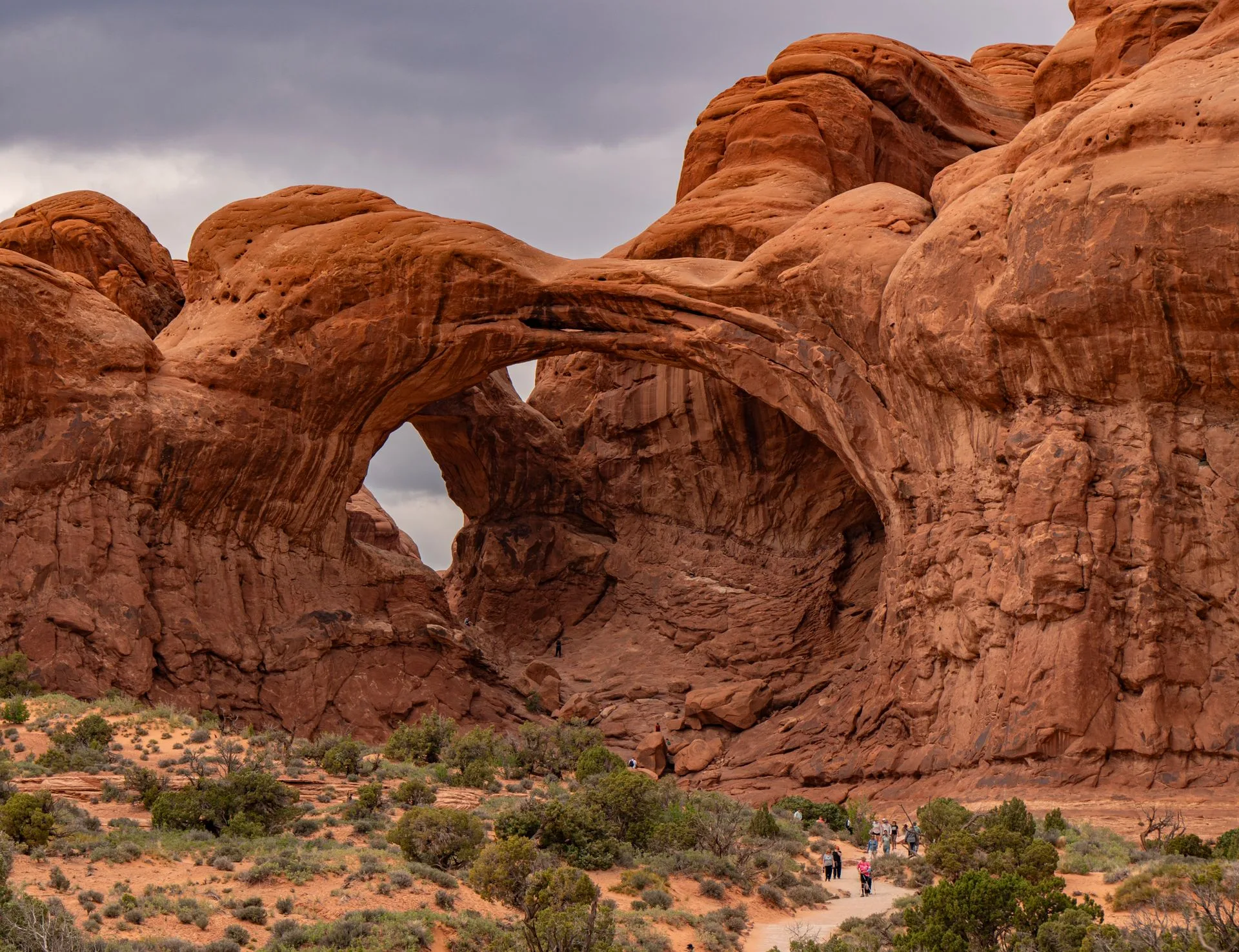
The trail to Delicate Arch runs three miles round trip with about 480 feet of elevation gain, most of it exposed rock with no shade cover for the majority of the route. The first half-mile is a well-defined path; after that, the trail turns to open slickrock and a narrow ledge for the final 200 yards before the arch comes into view. There is no shortcut and no scenic pullout that shows the arch from a car window. The National Park Service recommends carrying two to three liters of water per person for this hike, a real minimum in a desert park where summer temperatures regularly climb into the triple digits and shade is essentially nonexistent along the route.
- Arch height 52 FT
- Trail distance 3 MI ROUND TRIP
- Elevation gain 480 FT
- Water per person 2–3 LITERS MIN.
The Arch Has Tenants
White-throated swifts nest directly in Delicate Arch during the summer months, using crevices in the sandstone the same way the arch's own shape emerged: taking advantage of whatever the rock happens to offer. They're easy to miss against the red stone unless you know to look, small, fast-moving birds cutting past an arch that, by the time Beckwith got to it, had already survived every name the cowboys tried to pin on it.
Facts and figures checked against NPS.gov's Arches National Park materials, including its Delicate Arch trail and safety pages, and cross-referenced against the 1933–34 Beckwith expedition naming history.
The cowboys who named it the Schoolmarm's Bloomers weren't wrong about the shape, just about what to call it. Frank Beckwith fixed that in one winter, and the fix outlived every rancher who ever rode past the fin of rock it came from. Ninety years later, the swifts still nest in it every summer, the crowds still show up for sunset, and the arch still looks, if you squint the way a bored cowboy once did, exactly like a pair of very old bloomers.