
Balanced Rock stands 128 feet tall just off the main road through Arches National Park, close enough that most visitors see it from a car window without slowing down. What they're passing is a boulder the National Park Service puts at 3,600 tons, roughly the weight of a naval destroyer, resting on a stone pedestal that has been quietly eroding out from under it for longer than anyone has been alive to watch the whole process.
The Park Service doesn't hedge about where this ends. Balanced Rock will fall. The only open question is when, and the park's own history already has an answer for what that looks like: it happened to Balanced Rock's smaller twin fifty years ago.
A Boulder the Size of a Warship's Displacement
The whole formation, boulder and pedestal together, rises 128 feet above the desert floor. The boulder alone accounts for an estimated 3,600 tons of Entrada sandstone, a single piece of rock roughly comparable in weight to a World War II-era naval destroyer, held aloft on a narrower column of much older, softer stone. Seen from the road, it reads as improbable in the way a lot of Arches' formations do: too large and too oddly shaped to look like something that simply happened, rather than something built.
Why the Top Outlasts the Bottom
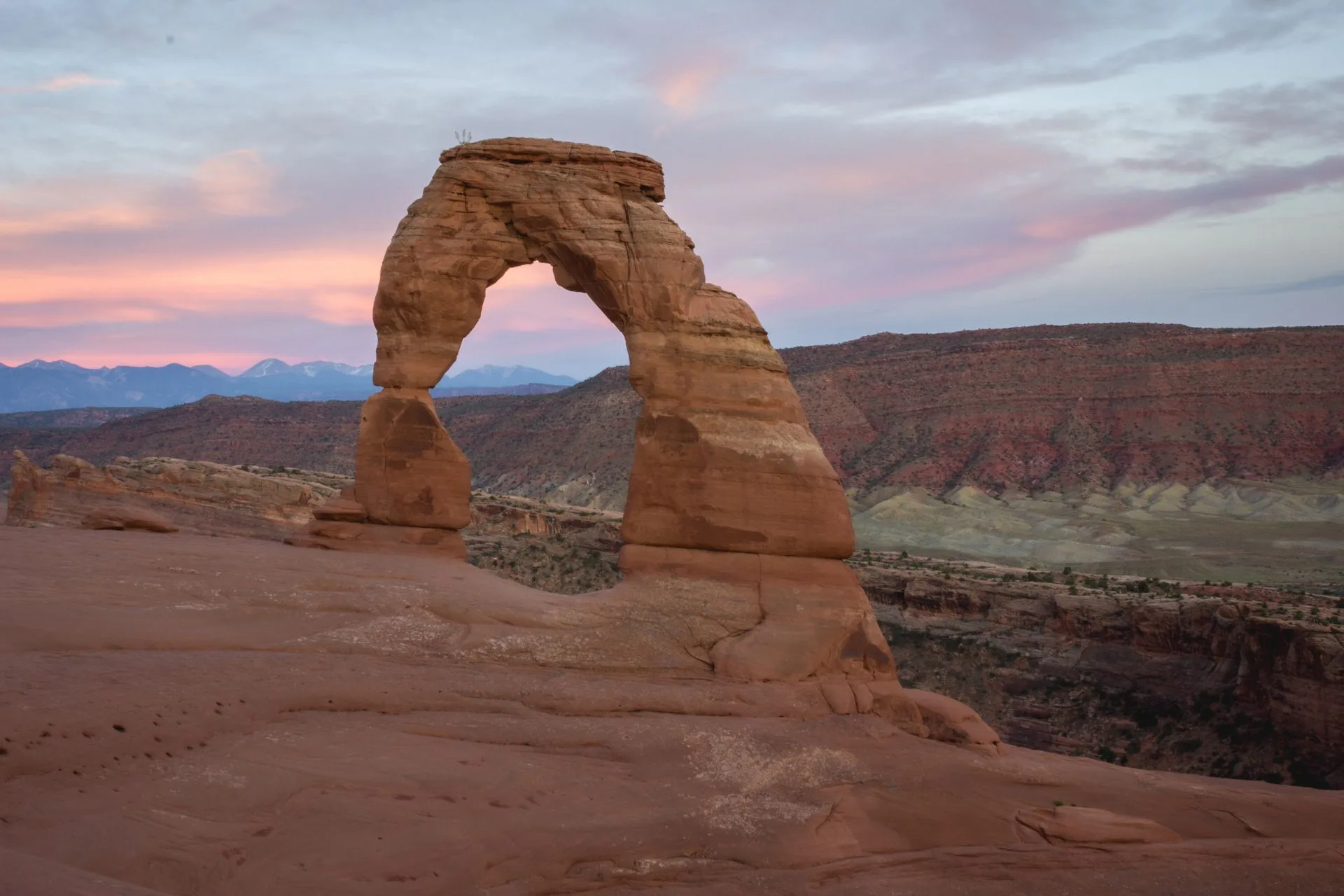
The formation exists because of a mismatch between two rock layers. The boulder on top is Entrada sandstone, dense and relatively erosion-resistant. What it sits on is Dewey Bridge mudstone, a softer, more easily worn layer that erodes faster under the same wind and water. Over enough time, the pedestal thins while the boulder above it stays roughly the same size, which is the same basic process behind Delicate Arch and every other formation in the park, just running in the opposite direction: instead of carving an opening, it's carving a boulder down to a stem too narrow to hold its weight.
See It From the Road or the Trail
Balanced Rock has a short loop trail for a closer look, plus a pullout for the drive-by view. The trip planner fits either into your Arches route.
Open the Trip PlannerChip Off the Old Block
Balanced Rock wasn't always alone. A smaller sibling formation stood nearby, similar in structure and popularly nicknamed Chip Off the Old Block. It collapsed during the winter of 1975 into 1976, undone by the same pedestal erosion that's still working on Balanced Rock today. Photographs from before the collapse show two balanced formations standing together; photographs from after show only one. It's the closest thing this park has to a preview.
- Total height 128 FT
- Boulder weight ~3,600 TONS
- Boulder rock type ENTRADA SANDSTONE
- Sibling collapse WINTER 1975–76
Not If, But When
The Park Service's own materials on Balanced Rock don't soften the outlook. Erosion that carved the formation in the first place is still active, and the agency states plainly that the rock will eventually come down as that process continues. No date is attached to that, and none should be. Wall Arch, elsewhere in the park, gave no warning before it fell overnight in 2008. Landscape Arch shed a slab in front of a crowd of visitors in 1991 with a few seconds' notice at most. Balanced Rock's collapse, whenever it comes, will likely look like one of those two: sudden, and probably over before anyone standing at the pullout has time to raise a camera.
Facts and figures checked against NPS.gov's Balanced Rock materials, including its stated boulder weight, formation height, and erosion outlook, and its published record of Chip Off the Old Block's 1975–76 collapse.
Chip Off the Old Block stood next to Balanced Rock for longer than any visitor today has been alive, until one winter fifty years ago it didn't. The pedestal that held it up was made of the same soft mudstone that's still holding up its bigger neighbor, thinning at the same patient rate. Every photograph anyone takes of Balanced Rock from the road is, whether they know it or not, a photograph of a rock in the process of finishing what erosion already did once nearby.