Ticket · advance booking recommended
Historic Tour
Moderate
2 mi540 stairs~2 hr
A walk through the cave's original entrance and some of its oldest-explored chambers, with steep stairs throughout.
 National
Kentucky · Park 39 / 64
The longest known cave system on Earth, with over 400 mapped miles and no sign of an end.
Mammoth Cave holds the record for the longest known cave system in the world, with more than 400 surveyed miles of passages, and cavers continue to map new sections almost every year. The scale is difficult to communicate: the next-longest cave system on the planet isn't even half this size, and geologists believe there may be hundreds of additional miles still undiscovered beneath the surrounding sandstone caprock.
Above ground, the Green River carves through forested hills dotted with sinkholes, and a small cable ferry, one of the last of its kind still operating anywhere, still carries cars across the river inside the park. Below ground, ranger-guided tours range from an easy elevator-accessed walk to strenuous, headlamp-lit crawls through undeveloped passages, all ticketed and prone to selling out by midday in the summer.
Come for the scale of what's mapped. Stay for the fact that no one actually knows how much more of it there is. Read the story, book your cave tour ahead, and when you leave, mark it visited.

The cave itself is far from ordinary, featuring zigzag tunnels, natural waterfalls, and stunning limestone formations shaped over millions of years.Adapted from visitor accounts of Mammoth Cave's Historic Tour
Six ways to spend your time, from a ticketed descent underground to a cable ferry crossing above it.
A two-hour ranger-guided walk through the original entrance, past chambers explored since the 1800s.
Ticket required · book aheadA small cable-operated ferry, one of the last of its kind, carrying two cars at a time across the river inside the park.
Free · 2 min crossingOne of the gentlest standard tours, ending at a dramatic flowstone formation resembling a frozen waterfall.
Ticket required · familiesA strenuous, crawling exploration into undeveloped passages, for those comfortable in tight, dark spaces.
Advanced · ticketed, limitedA surface loop past a massive sinkhole where an underground stream briefly reaches daylight.
Everyone · 1.5 hrThe starting point for every tour, with exhibits on the cave's history and current tour availability.
Everyone · essential first stopAnswer a few questions right here. We'll map your day, stop by stop, with a route, timings, weather, and a packing checklist grounded in real park data. No account, no leaving this page.
⚡ In a hurry? Adventure Light 5 questions →Every route rated honestly, with distance, climb, and a clear note on which cave tours need advance tickets.
A walk through the cave's original entrance and some of its oldest-explored chambers, with steep stairs throughout.
One of the gentlest tours, entered by bus from the visitor center, ending at a dramatic flowstone formation.
A forested surface loop with river overlooks and a good chance of spotting deer. No permit.
A loop to a massive sinkhole where an underground stream briefly surfaces before disappearing again. No permit.
A short surface walk near the visitor center to where an underground river spring reaches the Green River. No permit.
A strenuous exploration into undeveloped cave passages requiring crawling through tight spaces. Not for claustrophobia; coveralls and gear provided.
All cave tours require advance tickets, sold via Recreation.gov and often selling out same-day in peak season · no permit for surface trails · free park entry
Tap any animal to learn its story. Soon, the app will let you log what you spot and keep a life list for every park.
An endangered species found only in the cave waters of this region, adapted to complete darkness and stable underground temperatures.
Roosts in the cave system in large numbers, an endangered species highly sensitive to disturbance during hibernation.
Common throughout the park's forested surface trails, especially visible along the Green River Bluffs Trail.
Lives in the dim entrance areas of the cave where light still reaches, part of a specialized cave-edge ecosystem.
Has lost its eyes and pigmentation over generations of living in complete cave darkness, navigating instead by sensing water pressure changes.
Common in the park's forested uplands, often seen in small flocks near quieter trails.
Lives near cave entrances where some light still reaches, forming a key link between the surface and deep-cave food webs.
Common throughout the park's surface forests, one of the tallest hardwood species in the eastern United States.
Blooms across the forest floor each spring, a reliable indicator of the mature, undisturbed woodland found throughout much of the park.
Common in the park's hardwood forest, tolerant of the deep shade found beneath the taller canopy trees.
Forms dense colonies across the forest floor each spring, its umbrella-like leaves a familiar sight along shaded trails.
Grows only in the dim light near cave entrances, unable to survive in either full darkness or full sun.
Common around the park's numerous sinkholes, tolerant of the thin, well-drained soil found in those areas.
Mammoth Cave holds the record for the longest known cave system on Earth, with over 400 surveyed miles of passages.
The next-longest known cave system in the world is less than half the length of Mammoth Cave.
The park is a designated UNESCO World Heritage Site and International Biosphere Reserve, recognized for both its geology and biodiversity.
The Green River Ferry is one of the last operating cable ferries of its kind still carrying vehicles across a river in the United States.
The questions people actually ask, answered from the park’s own current guidance. Fees and permit rules change every year, so each answer links back to the National Park Service page it came from.
There's no fee to enter the park itself. You only pay when you book a cave tour, and prices vary a lot by tour: the short Discovery Tour is $12 for an adult, while the strenuous Wild Cave Tour runs $79. Holders of a Senior or Access pass get 50% off tour tickets for themselves. Source: NPS.gov
Yes, reservations through Recreation.gov are the only reliable way to get on a tour, since walk-up availability isn't guaranteed on any given day. You can also book by calling 877-444-6777. Popular tours and weekends fill up, so book ahead rather than counting on same-day tickets. Source: NPS.gov
Yes, the park welcomes visitors any time of year and publishes separate guides for fall, winter, spring, and summer trips. Cave temperatures stay a cool, constant 54°F underground regardless of the season, so tours continue through the winter, though specific tour offerings can shift seasonally. Source: NPS.gov
Mammoth Cave offers about a dozen distinct tours ranging from the easy, half-hour Discovery Tour (130 stairs) up to the strenuous Wild Cave Tour, a crawling, climbing trip for ages 16 and up. In between are options like the 2-hour Historic Tour (540 stairs), the lantern-lit Great Onyx Tour, and a fully wheelchair-accessible tour, so pick based on your group's fitness and how much of the cave's history versus formations you want to see. Source: NPS.gov
Stories, guides, and hard-won tips from the trail. The full Mammoth Cave deep dive lives on the blog.
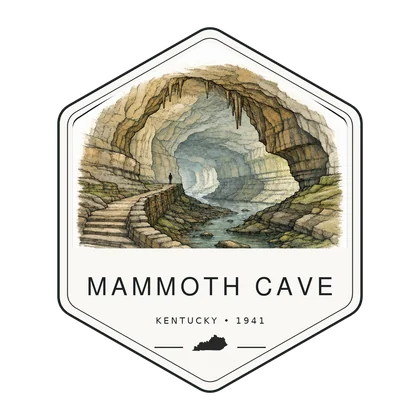
Log the visit, keep your story, and watch the map of all sixty-four fill in behind you. Every visit has a keepsake worth holding.
See the full map and track every park you have visited.
View the map → PlanTurn Mammoth Cave into a trip with a custom, day-by-day itinerary.
Start planning → Go deeperStephen Bishop was enslaved, and became the best cave guide of his century. Here's his full story.
Read it → Explore moreFind your next park anywhere in the country.
Browse parks →
Offline maps, your passport, and every park in your pocket on the trail.
Join the waitlist →
The printed edition, part atlas, part journal, one story per park.
Notify me →Park-guide posters, enamel stamps, and the passport book to fill in.
Visit the shop →Field Notes
The parks do not perform for anyone. They stood here before the road, and they will stand here after it.