Exit Glacier Trail
Easy
1 mi round trip+100 ft~45 min
A short, paved and gravel trail from the parking area to the glacier's face. No permit.
 National
Alaska · Park 56 / 64
A range of coastal mountains slowly sinking into the sea, more than half the park buried under an icefield larger than Rhode Island.
Kenai Fjords protects a range of coastal mountains that are, quite literally, slowly sinking into the ocean, their former glacial valleys transformed into the long, steep-walled fjords that give the park its name. More than half of the park's total area lies buried under the Harding Icefield, the largest icefield entirely within the United States, thick enough in places to exceed a mile, with only the very tops of mountain peaks, called nunataks, breaking through the surface.
Exit Glacier is the only part of the park reachable by road, and its retreat has been dramatic enough that trail markers along the approach show, year by year, how much further back the ice has pulled since the early 2000s. Beyond Exit Glacier, the rest of the park is reached almost entirely by boat, with tour operators in Seward running day trips into Resurrection Bay and the fjords beyond to see tidewater glaciers calve into the sea alongside whales, sea otters, and sea lions.
Come for the boat tour into the fjords, the only realistic way most visitors experience this park's true scale. Stay to hike the Harding Icefield Trail if your legs and weather allow it. Read the story, book the boat ahead, and when you leave, mark it visited.

The best way to judge the immensity of the Harding Icefield is to see it from above, whether by scenic flight or from the trail's end after a full day's climb.Adapted from a photographer's account of exploring Kenai Fjords National Park
Six ways to spend your time, from the one road-accessible glacier to a boat trip into fjords few visitors ever reach on foot.
The only realistic way to see most of the park, with day trips from Seward reaching tidewater glaciers and abundant marine wildlife.
The signature trip · book aheadA strenuous full-day climb ending at a view over an icefield larger than Rhode Island, the park's single official trail.
Full day · very strenuousThe only part of the park reachable by road, with a short, easy trail to the glacier's retreating face.
Everyone · 1.5 hrLocated in downtown Seward rather than inside the park itself, since almost nothing else is road-accessible.
Everyone · 30 minGuided kayak trips get close to tidewater glaciers and wildlife in a way large tour boats can't match.
Full day · guided toursHumpback and orca sightings are common on boat tours departing directly from Seward's harbor.
Everyone · on any boat tourAnswer a few questions right here. We'll map your day, stop by stop, with a route, timings, weather, and a packing checklist grounded in real park data. No account, no leaving this page.
⚡ In a hurry? Adventure Light 5 questions →This park has essentially one official maintained trail; everything else is boat-based. Rated honestly below.
A short, paved and gravel trail from the parking area to the glacier's face. No permit.
A relentless climb through Marmot Meadows to a viewpoint over the vast Harding Icefield. Plan a full day; no shortcuts. No permit.
A day-trip boat tour into Resurrection Bay and the fjords, the primary way most visitors experience the park's scale.
A guided kayak trip closer to tidewater glaciers than large tour boats can safely approach.
A handful of public-use cabins accessible by boat or plane along the park's coastline, requiring advance reservation.
Off-trail travel across the Harding Icefield itself, requiring real glacier travel experience and crevasse awareness.
No permit for Exit Glacier or the Harding Icefield day trail · free backcountry permits recommended for remote travel · nearly the entire park beyond Exit Glacier requires a boat or plane
Tap any animal to learn its story. Soon, the app will let you log what you spot and keep a life list for every park.
Common in Resurrection Bay and the surrounding fjords during the summer feeding season, a highlight of most boat tours.
Both resident fish-eating pods and transient mammal-hunting pods are seen in the park's waters.
Common throughout the park's calmer coastal waters, often seen floating on their backs near kelp beds.
Forms large colonies on rocky islands throughout the fjords, often visible and audible from tour boats.
Common on the steep terrain surrounding Exit Glacier and the Harding Icefield Trail.
Present throughout the park's coastal forest, occasionally visible from the Harding Icefield Trail's lower sections.
Common throughout the park's coastline, frequently perched near the water watching for fish.
Dominates the park's coastal rainforest, part of the temperate rainforest ecosystem found along much of coastal Alaska.
Common along the Exit Glacier approach and other disturbed ground, a fast-colonizing wildflower found throughout Alaska.
Covers the higher elevations along the Harding Icefield Trail, a hardy community adapted to short growing seasons.
Common alongside Sitka spruce in the park's coastal rainforest zones.
Often among the first plants to establish on ground recently exposed by the retreating Exit Glacier.
Among the few organisms able to survive on the exposed rock peaks, called nunataks, that break through the Harding Icefield.
More than half of Kenai Fjords National Park lies buried under the Harding Icefield, larger in area than the state of Rhode Island.
The Harding Icefield is more than a mile thick in places, with only mountain peaks called nunataks breaking through its surface.
Exit Glacier's retreat has been dramatic and well-documented, with dated trail markers showing the ice's former positions since the early 2000s.
The park's coastal mountains are slowly sinking into the sea, a process called isostatic subsidence that continues to reshape the fjords.
The questions people actually ask, answered from the park’s own current guidance. Fees and permit rules change every year, so each answer links back to the National Park Service page it came from.
No, Kenai Fjords charges no entrance fee. You'll still pay separately for things like a boat tour into the fjords or a night in a park cabin, since those run outside the general fee program. Source: NPS.gov
You do if you want one of the park's public use cabins. The coastal cabins run $75 a night in summer and the Willow Cabin near Exit Glacier is $50 a night in winter, both booked ahead of time. The 12-site tent campground at Exit Glacier, by contrast, is free and first-come, first-served with no reservation needed. Source: NPS.gov
No. The road into the Exit Glacier area is the only way to drive into the park, and it isn't plowed in winter, so it's closed to cars roughly from October through May depending on snowfall. The park stays open year-round even when the road doesn't, and in winter you can still reach the area on skis, a fat bike, or a snowmachine. Source: NPS.gov
The park recommends carrying bear spray whenever you're out in Kenai Fjords and using bear-resistant food storage containers for anything you're camping with. Trails here are few but steep, rocky, and uneven, so pair your bear precautions with sturdy footwear and caution near drop-offs and ice. Source: NPS.gov
Stories, guides, and hard-won tips from the trail. The full Kenai Fjords deep dive lives on the blog.
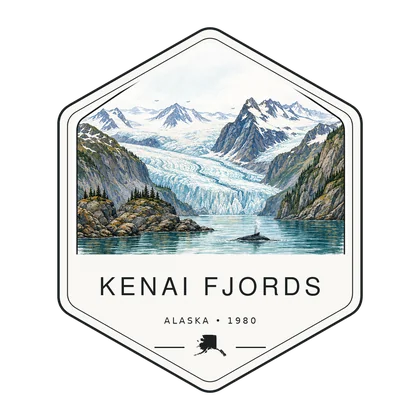
Log the visit, keep your story, and watch the map of all sixty-four fill in behind you. Every visit has a keepsake worth holding.
See the full map and track every park you have visited.
View the map → PlanTurn Kenai Fjords into a trip with a custom, day-by-day itinerary.
Start planning → Go deeperResident, transient, and offshore orcas all pass through Kenai Fjords, and one small pod never recovered from 1989.
Read it → Explore moreFind your next park anywhere in the country.
Browse parks →
Offline maps, your passport, and every park in your pocket on the trail.
Join the waitlist →
The printed edition, part atlas, part journal, one story per park.
Notify me →Park-guide posters, enamel stamps, and the passport book to fill in.
Visit the shop →Field Notes
The parks do not perform for anyone. They stood here before the road, and they will stand here after it.