Stoll Trail
Easy–Mod
4.2 mi+250 ft~2.5 hr
A rocky loop from Rock Harbor to Scoville Point, the most popular and accessible hike on the island. No permit.
 National
Michigan · Park 37 / 64
An island in the middle of Lake Superior, reachable only by boat or seaplane, closed entirely every winter.
Isle Royale is the least-visited national park in the contiguous United States, not because it isn't worth visiting, but because reaching it takes real commitment: a ferry ride of one and a half to six hours across Lake Superior, the largest freshwater lake on Earth, or a seaplane flight from the mainland. There are no roads and no cars anywhere on the island; everything beyond the dock happens on foot, by canoe, or by private boat.
The island is also famous among ecologists for a decades-long predator-prey study of its moose and wolf populations, isolated enough from the mainland that their numbers rise and fall in a rare, closely watched natural cycle. Isle Royale is the only national park that closes entirely each winter, from November 1 through mid-April, both for visitor safety and to give researchers exclusive access to the frozen island.
Come for the isolation. Stay for the fact that very few people ever make the trip, so most of what you find, you'll find largely alone. Read the story, book your ferry well ahead, and when you leave, mark it visited.

Cross Lake Superior and make a commitment: become a part of this island, and let it become a part of you.National Park Service, on visiting Isle Royale
Six ways to spend your time, all of them starting with a boat ride across Lake Superior.
The classic approach, from one and a half to six hours depending on departure point, itself a scenic highlight of the trip.
The signature journey · book aheadA rocky loop near Rock Harbor with lake views and interpretive stops, the most accessible walk on the island.
Half day · easiest trailA rugged point at the end of the Stoll Trail with sweeping views of Lake Superior and the Canadian shoreline.
Everyone · turnaround pointThe main hub for arrivals, with the island's lodge, camp store, and ranger information desk.
Everyone · plan your stayA 40-mile trail running the length of the island, the classic Isle Royale backpacking route.
Multi-day · experienced backpackersThe island's isolated moose and wolf populations are the subject of one of the longest-running predator-prey studies in ecology.
Patient observers · no guaranteeAnswer a few questions right here. We'll map your day, stop by stop, with a route, timings, weather, and a packing checklist grounded in real park data. No account, no leaving this page.
⚡ In a hurry? Adventure Light 5 questions →Every route rated honestly, with distance, climb, and a reminder that everything here starts and ends with a boat.
A rocky loop from Rock Harbor to Scoville Point, the most popular and accessible hike on the island. No permit.
A short loop near Rock Harbor to a sea cave carved when Lake Superior's water level was higher. No permit.
A short loop near the Windigo Visitor Center on the island's western end. No permit.
A climb along part of the Greenstone Ridge to a summit view over the island's interior lakes. Camping permit required for overnight stays.
The island's classic backpacking route, running the full length of Isle Royale. A backcountry permit is required for all overnight camping.
A network of interior lakes connected by portage trails, reachable only after arriving by ferry or seaplane.
No permit for day hikes · backcountry camping permits required for all overnight stays, arranged through the park · park closed entirely Nov 1 through mid-April
Tap any animal to learn its story. Soon, the app will let you log what you spot and keep a life list for every park.
Isle Royale's moose population, isolated from the mainland, has been studied continuously for decades as part of one of ecology's longest-running predator-prey research projects.
Wolves cross to the island only rarely on winter ice; a small population has been reinforced through relocation to help control the moose population.
Common throughout the island's forest, its coat changing from brown to white with the seasons.
Nests on the island's quieter interior lakes, its distinctive call a defining sound of a summer evening here.
Native to the deep, cold waters surrounding the island, a draw for anglers with the appropriate license.
Present throughout the island, generally more visible near developed areas like Rock Harbor than in the deep interior.
Emerges in large numbers from the surrounding lake in early summer, an indicator of healthy water quality in Lake Superior.
Dominates much of the island's interior, a classic boreal forest ecosystem more typical of land far to the north.
Common throughout the island's forest, especially visible in the golden colors of a short northern fall.
A wild berry common along many of the island's trails, edible and popular with both wildlife and hikers.
A low, white-flowered groundcover common in the island's shaded forest floor, turning bright red berries by late summer.
Covers much of the island's exposed bedrock, part of the earliest stages of soil formation on this glaciated landscape.
Common along the island's rocky shorelines, tolerant of the thin soil and exposure found there.
Isle Royale is the least-visited national park in the contiguous United States, receiving fewer annual visitors than many parks see in a single day.
The island's moose and wolf populations are the subject of one of the longest-running predator-prey studies in the field of ecology.
Isle Royale is the only national park that closes entirely each winter, from November 1 through mid-April.
There are no roads or cars anywhere on the island; all travel beyond the dock happens on foot, by canoe, or by private boat.
The questions people actually ask, answered from the park’s own current guidance. Fees and permit rules change every year, so each answer links back to the National Park Service page it came from.
Isle Royale charges $7 per person per day to enter or stay in the park, with kids 15 and under exempt. If you're going more than once, an annual pass is $60 and covers you plus up to three additional adults. That's on top of whatever you pay for the ferry or seaplane to actually get there. Source: NPS.gov
Yes, the NPS-operated Ranger III requires an advance reservation, made through a two-step process: check seat and motorboat-space availability on the park's website, then book through pay.gov. For 2026 it runs a fixed schedule, departing Houghton Tuesdays and Fridays at 9 am and returning from the island Wednesdays and Saturdays. Source: NPS.gov
Isle Royale runs April 16 through October 31 and is completely closed the rest of the year, from November 1 to April 15. NPS cites extreme winter weather and visitor safety, and the closure even extends 4.5 miles out into Lake Superior around the island. During that stretch, park operations move to the mainland office in Houghton, Michigan. Source: NPS.gov
Stories, guides, and hard-won tips from the trail. The full Isle Royale deep dive lives on the blog.
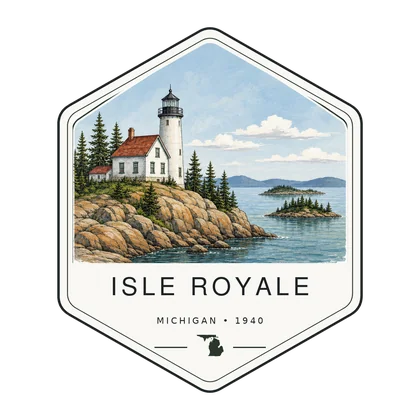
Log the visit, keep your story, and watch the map of all sixty-four fill in behind you. Every visit has a keepsake worth holding.
Another Great Lakes-region wilderness reachable mostly by water, west in Minnesota.
Open Park 36 → The collectionSee the full map and track every park you have visited.
View the map → PlanTurn Isle Royale into a trip with a custom, day-by-day itinerary.
Start planning → Go deeperIsle Royale's wolves fell to just two before rangers relocated nineteen more. The world's longest predator-prey study is watching a dramatic reversal.
Read it →
Offline maps, your passport, and every park in your pocket on the trail.
Join the waitlist →
The printed edition, part atlas, part journal, one story per park.
Notify me →Park-guide posters, enamel stamps, and the passport book to fill in.
Visit the shop →Field Notes
The parks do not perform for anyone. They stood here before the road, and they will stand here after it.