Dunes Overlook Trail
Easy
1 mi+100 ft~30 min
A short forested walk from the visitor center to an overlook of the entire dune field. No permit.
 National
Colorado · Park 18 / 64
The tallest dunes in North America, sitting where a desert has no business being, ringed by 13,000-foot peaks.
Colorado is not a place most people associate with sand dunes, which is exactly what makes this park so disorienting in the best way. Wind sweeping across the San Luis Valley for millennia has piled sand against the base of the Sangre de Cristo Mountains, building the tallest dune field in North America, with Star Dune topping out around 750 feet, all of it sitting at 8,200 feet elevation and ringed by peaks over 13,000 feet.
Every spring, snowmelt from the mountains creates Medano Creek along the dune field's edge, a shallow, surge-flowing stream that behaves almost like a tide pool, rising and falling in pulses that kids can wade in and adults inexplicably cannot stop watching. It usually dries up by midsummer, so the timing matters if that's the draw.
Come for the surreal scale of the dunes. Stay for the night sky, among the darkest certified anywhere in the country. Read the story, trust the live data above for what is open today, and when you leave, mark it visited.

The desert is not a wasteland, but a mysterious and lovely place, waiting for people to see it with more than their eyes.Adapted from Minerva Hoyt, whose desert-protection advocacy shaped early National Park Service policy
Six ways to spend your time, from wading a surge-flow creek to sandboarding down a 700-foot dune.
A shallow, pulsing stream at the base of the dunes, usually flowing from April through June, gone by midsummer.
Families · springRent a board in nearby towns; the park doesn't rent them. The dunes make for a genuinely fast, if sandy, ride down.
The signature activityAn International Dark Sky Park where the Milky Way is visible without any equipment on a clear new-moon night.
Stargazers · after darkA short, steep trail to a waterfall tucked in a narrow slot canyon, with a view back over the dune field from the approach road.
Half day · easy add-onThe only campground inside the park, with dune-field views right from many sites. Reserve ahead in peak season.
Campers · book aheadA short walk from the visitor center to a view over the entire dune field and the mountains behind it.
Everyone · 20 minAnswer a few questions right here. We'll map your day, stop by stop, with a route, timings, weather, and a packing checklist grounded in real park data. No account, no leaving this page.
⚡ In a hurry? Adventure Light 5 questions →Every trail rated honestly, with distance, climb, and a reminder that there are no marked paths on the sand itself.
A short forested walk from the visitor center to an overlook of the entire dune field. No permit.
No trail, just the shallow creek at the dune field's edge. Flows strongest with mountain snowmelt from April through June. No permit.
No marked trail; the route is whatever ridge you choose to follow up loose sand. A commanding view once you're up, and a genuine workout getting there. No permit.
The tallest dune in North America, reached by an exposed sand trek with no shade and no marked route. Start at dawn and carry more water than seems reasonable. No permit.
A rocky creekside scramble to a waterfall tucked into a narrow canyon just outside the main dune field. No permit.
A forested climb through Montville Nature Trail into a mountain pass, a cool contrast to the exposed sand elsewhere in the park. No permit.
Free backcountry permits at the visitor center for overnight camping · no permit for day hikes on the dunes or trails
Tap any animal to learn its story. Soon, the app will let you log what you spot and keep a life list for every park.
Almost never needs to drink free water at all, extracting what it needs from seeds. Its tracks are common on the dunes at dawn, though the animal itself is rarely seen.
Common in the grasslands and forest edges surrounding the dune field, especially active at dawn and dusk.
Works the high, rocky terrain of the mountains ringing the dunes, occasionally visible from the Mosca Pass trail.
A species found only in this dune field and nowhere else on Earth, adapted specifically to life on shifting, sun-baked sand.
Present in the forested slopes bordering the dune field, rarely encountered on the open sand itself.
Hunts the open grasslands and dune edges, occasionally visible riding thermals off the Sangre de Cristo foothills.
Digs extensive burrow systems beneath the dune surface, emerging only at night to forage, leaving distinctive tracks each morning.
One of the few plants able to root directly in shifting sand, helping stabilize the dune edges where grassland meets the dune field.
Tracks the seasonal path of Medano Creek, the only reliable sign of where the water flows each spring before it dries up.
A low, silvery-leaved plant found along the dune margins, tough enough to survive the extreme heat of the exposed sand.
Common in the grasslands surrounding the dunes, blooming with bright yellow flowers in late spring.
Covers the lower slopes of the Sangre de Cristo range bordering the park, giving way to alpine tundra higher up.
A low, fragrant flower that appears on the dune margins after summer rains, one of the few blooms tough enough for the shifting sand.
Star Dune rises about 750 feet from base to summit, making it the tallest dune in North America.
The dune field sits at roughly 8,200 feet elevation, ringed by peaks in the Sangre de Cristo range that top 13,000 feet.
Medano Creek's surge-flow pattern, rising and falling in pulses, is a rare phenomenon found in very few places on Earth.
Great Sand Dunes is an International Dark Sky Park, among the darkest night skies certified anywhere in the contiguous United States.
The questions people actually ask, answered from the park’s own current guidance. Fees and permit rules change every year, so each answer links back to the National Park Service page it came from.
A private vehicle pass is $25 for 7 days, a motorcycle is $20, and a person on foot or bike pays $15. An annual park pass is $45. Source: NPS.gov
No. The park has no timed entry, advance reservation requirement, or visitor cap. Buying your entrance pass ahead of time is available but entirely optional. Source: NPS.gov
In a typical year the creek starts trickling at the main dunes parking area in April and peaks in late May or early June, then dries up by July. 2026 has been an exception: low snowpack meant the creek bed was still dry at the parking lot as of this spring, with flow staying well upstream. Check the park's current conditions page before planning a creek trip. Source: NPS.gov
No permit is needed, but regular snow sleds, saucers, or cardboard won't work, the dry sand is too soft for them to slide on. You need a sand sled or sandboard made for it, which local shops just outside the park rent out. Source: NPS.gov
Stories, guides, and hard-won tips from the trail. The full Great Sand Dunes deep dive lives on the blog.
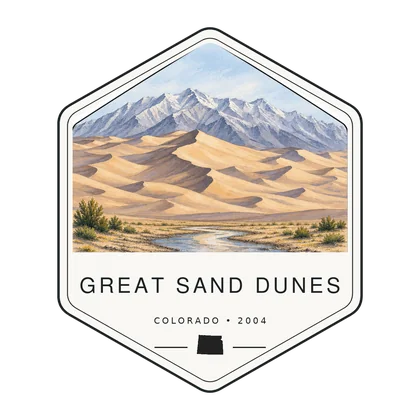
Log the visit, keep your story, and watch the map of all sixty-four fill in behind you. Every visit has a keepsake worth holding.
North through Colorado: from a desert of sand to a tundra above the trees.
Open Park 11 → The collectionSee the full map and track every park you have visited.
View the map → PlanTurn Great Sand Dunes into a road trip with a custom, day-by-day itinerary.
Start planning → Go deeperHigh Dune gets all the foot traffic. Star Dune, nearly fifty feet taller, is the real record holder.
Read it →
Offline maps, your passport, and every park in your pocket on the trail.
Join the waitlist →
The printed edition, part atlas, part journal, one story per park.
Notify me →Park-guide posters, enamel stamps, and the passport book to fill in.
Visit the shop →Field Notes
The parks do not perform for anyone. They stood here before the road, and they will stand here after it.