Fort Jefferson Self-Guided Tour
Easy
1 miflat, some stairs~1.5 hr
A walking loop through the fort's parade ground, walls, and interior, with interpretive plaques throughout. No permit.
 National
Florida · Park 50 / 64
A massive unfinished fort, seventy miles from the nearest road, built from 16 million bricks on a speck of sand in the Gulf of Mexico.
Fort Jefferson, the centerpiece of Dry Tortugas National Park, is the largest masonry structure in the Western Hemisphere, built from over 16 million bricks on a tiny island roughly 70 miles from the nearest paved road. Construction began in 1846 and never fully finished, a coastal fortress rendered strategically obsolete by advances in weaponry before its guns were ever fired in battle, though it did serve as a Civil War prison, most famously holding Dr. Samuel Mudd, convicted of aiding Abraham Lincoln's assassin.
The park itself is made up of seven small islands, and getting there requires real commitment: a roughly two-and-a-half-hour high-speed ferry ride or a shorter but pricier seaplane flight from Key West, since there's no other way in. Once there, the reward is turquoise water, some of the best snorkeling in the Florida Keys right off the fort's walls, and a genuine sense of isolation that's increasingly rare this close to a major tourist destination.
Come for the fort. Stay for the water around it. Read the story, book your ferry or seaplane well ahead, and when you leave, mark it visited.

Words can't describe how cool it is here. Put this on your bucket list, whether you get there by air or by sea, just get there.Adapted from visitor accounts of reaching Fort Jefferson at Dry Tortugas
Six ways to spend your time, once you've made the ferry or seaplane trip to get there.
A self-guided walking tour through the largest masonry fort in the Americas, with interpretive plaques throughout.
The signature stopSome of the best easy snorkeling in the Florida Keys, right off the fort's walls with no boat required once you're there.
Half day · bring your own gear or rentThe largest island in the Dry Tortugas, home to a historic lighthouse and named for its abundant loggerhead sea turtles.
Half day · boat access from Garden KeyA small, primitive campground beside the fort, offering a rare chance at truly dark skies far from any city.
Advance reservation requiredFort Jefferson served as a Union prison, most famously holding Dr. Samuel Mudd, convicted of aiding Lincoln's assassin.
Everyone · self-guidedThe remote islands are a significant stopover for migratory birds, drawing dedicated birders each spring and fall.
Birders · spring & fallAnswer a few questions right here. We'll map your day, stop by stop, with a route, timings, weather, and a packing checklist grounded in real park data. No account, no leaving this page.
⚡ In a hurry? Adventure Light 5 questions →This park is more fort-and-water than trail network, so here's every route rated honestly.
A walking loop through the fort's parade ground, walls, and interior, with interpretive plaques throughout. No permit.
A shallow, calm snorkel route right along the fort's outer wall, good for beginners. No permit.
A short beach walk around the small island beyond the fort itself. No permit.
A walk around the largest island in the Dry Tortugas, past a historic lighthouse.
Climbing the fort's interior staircases to upper levels for views over the surrounding water. No permit.
A small, primitive campground beside the fort, requiring visitors to bring all their own food and water via the ferry.
No permit for day visits to the fort or moat wall · overnight camping requires an advance reservation with the ferry operator · reachable only by ferry, seaplane, or private boat
Tap any animal to learn its story. Soon, the app will let you log what you spot and keep a life list for every park.
Nests in large numbers on Bush Key adjacent to Garden Key, one of the most significant sooty tern colonies in the country.
Gave Loggerhead Key its name due to the abundance of this species nesting and foraging in the surrounding waters.
One of the largest reef fish in the Atlantic, occasionally visible to snorkelers right along the fort's moat wall.
Commonly seen soaring over the islands, identifiable by its long, forked tail and massive wingspan.
Frequently seen resting in the shallow water around Garden Key, generally docile and non-aggressive toward snorkelers.
The remote islands serve as an important rest stop for migratory birds crossing the Gulf of Mexico each spring and fall.
Common in the seagrass beds surrounding the islands, occasionally visible from the fort's walls in clear water.
One of the few woody shrubs able to survive on the small, salt-exposed islands of the Dry Tortugas.
A low, salt-tolerant groundcover common along the sandy edges of Garden Key.
Forms underwater meadows around the islands, critical foraging habitat for the area's sea turtles.
A few scattered palms grow on Garden Key, though the islands' native vegetation is otherwise sparse and salt-adapted.
A trailing beach vine that helps stabilize loose sand on the islands' shorelines.
The waters around the Dry Tortugas support healthy coral reef structures, part of the broader Florida Reef system.
Fort Jefferson is the largest masonry structure in the Western Hemisphere, built from more than 16 million bricks.
The Dry Tortugas are located roughly 70 miles west of Key West, reachable only by boat or seaplane.
During the Civil War, Fort Jefferson served as a military prison, most notably holding Dr. Samuel Mudd, convicted of aiding Lincoln's assassin.
The fort's construction, begun in 1846, was never fully completed, rendered strategically obsolete by advances in rifled weaponry before it saw combat.
The questions people actually ask, answered from the park’s own current guidance. Fees and permit rules change every year, so each answer links back to the National Park Service page it came from.
Entrance is $15 per person and covers 7 consecutive days. Children under 16 don't pay. This is separate from whatever you pay for the ferry or seaplane ride out to the park. Source: NPS.gov
You don't need a permit to enter, but you do need to book your ride there. Both the ferry (run by the Yankee Freedom concessionaire) and the seaplane service require advance reservations, since there's no bridge or regular public dock access to Fort Jefferson. Private boat owners can visit without a reservation, mooring space and weather permitting. Source: NPS.gov
Yes, camping is allowed at the campground next to Fort Jefferson on Garden Key. Individual campsites are first-come, first-served with no advance reservation needed, at $15 per night per site. Groups of 10 or more have to reserve the group site in advance, and campers arriving by ferry need to coordinate gear with the ferry operator since the seaplane doesn't carry camping equipment. Source: NPS.gov
Stories, guides, and hard-won tips from the trail. The full Dry Tortugas deep dive lives on the blog.
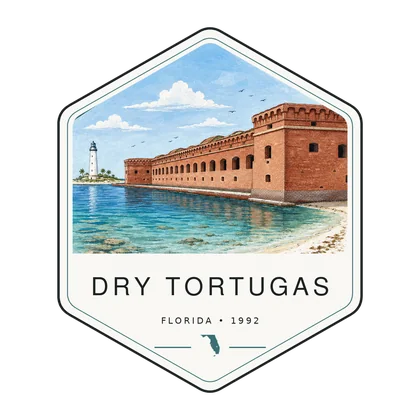
Log the visit, keep your story, and watch the map of all sixty-four fill in behind you. Every visit has a keepsake worth holding.
Back toward the mainland, near Miami: another Florida park reachable mostly or entirely by boat.
Open Park 49 → The collectionSee the full map and track every park you have visited.
View the map → PlanTurn Dry Tortugas into a trip with a custom, day-by-day itinerary.
Start planning → Go deeperFort Jefferson took thirty years to build and was never finished. By the time construction was winding down, new weapons had already made it obsolete.
Read it →
Offline maps, your passport, and every park in your pocket on the trail.
Join the waitlist →
The printed edition, part atlas, part journal, one story per park.
Notify me →Park-guide posters, enamel stamps, and the passport book to fill in.
Visit the shop →Field Notes
The parks do not perform for anyone. They stood here before the road, and they will stand here after it.