Brandywine Falls Boardwalk
Easy
0.5 mi+100 ft~30 min
A short walk with stairs down to the base of the park's signature 65-foot waterfall. No permit.
 National
Ohio · Park 40 / 64
A national park tucked between two cities, proof that Ohio's only national park doesn't need to be remote to be worth a trip.
Cuyahoga Valley sits along the winding Cuyahoga River almost exactly between Cleveland and Akron, close enough that many visitors arrive on a whim rather than a planned pilgrimage, and became a full national park only in 2000 after decades as a national recreation area. The name Cuyahoga, from an Indigenous word usually translated as crooked river, describes the waterway that once famously caught fire in 1969, a pollution disaster that helped spark the modern environmental movement and, eventually, the river's recovery.
Brandywine Falls, a 65-foot cascade reached by an easy boardwalk, is the park's most photographed spot, but the 20-mile Ohio and Erie Canal Towpath Trail is arguably its backbone, following the historic canal route past locks, wetlands, and the occasional passing scenic railroad. The Ledges Trail, with sandstone cliffs and narrow passages between boulders, feels almost like a different park entirely from the flat towpath a few miles away.
Come for how easy this is to reach. Stay for the fact that it doesn't feel like a park squeezed between two metro areas at all. Read the story, trust the live data above for what is open today, and when you leave, mark it visited.

Cuyahoga Valley National Park is an awesome surprise and proof you don't have to head out west to find great scenery and outdoor adventure.Adapted from visitor accounts of Cuyahoga Valley's Boston Mill Visitor Center
Six ways to spend your time, from a waterfall boardwalk to a scenic train ride along the old canal.
A short, easy boardwalk to the park's tallest and most photographed waterfall, a 65-foot cascade.
The signature walkA flat, 20-mile trail along the historic Ohio and Erie Canal, doable in sections of any length.
Casual to full dayA restored 19th-century covered bridge over a small creek, one of the park's most photographed structures.
Everyone · 15 minA loop through sandstone cliffs and narrow rock passages, the most dramatic terrain in the park.
Half day · confident hikersA boardwalk through a restored wetland with reliable turtle, bird, and beaver sightings.
Families · 30 minA historic train running through the park along the same route the towpath follows, with several boarding stations.
Half day · ticketedAnswer a few questions right here. We'll map your day, stop by stop, with a route, timings, weather, and a packing checklist grounded in real park data. No account, no leaving this page.
⚡ In a hurry? Adventure Light 5 questions →Every trail rated honestly, with distance, climb, and a note on which ones are flat towpath and which are true hiking.
A short walk with stairs down to the base of the park's signature 65-foot waterfall. No permit.
A flat, crushed-limestone trail along the historic canal route, walkable or bikeable in sections of any length. No permit.
A loop through sandstone cliffs, narrow rock passages, and an overlook increasingly obscured by tree growth. No permit.
A flat boardwalk over a restored wetland, reliable for turtles, birds, and the occasional beaver. No permit.
A short, easy walk to and around a restored 19th-century covered bridge over Furnace Run. No permit.
The Cuyahoga Valley segment of Ohio's long-distance Buckeye Trail, connecting many of the park's other trails end to end. No permit.
No permit for any trail · free park entry with no entrance fee · scenic railroad tickets sold separately through the excursion operator
Tap any animal to learn its story. Soon, the app will let you log what you spot and keep a life list for every park.
Returned to nest in the valley after decades of absence following the river's pollution recovery, now a conservation success story visible along the Cuyahoga.
Responsible for creating the Beaver Marsh itself, damming a former industrial site into the wetland that now bears its name.
Found throughout the park's forests, especially visible along quieter towpath sections at dawn and dusk.
Common in and around the Beaver Marsh boardwalk, a reliable and easy wildlife sighting for families.
Present throughout the park's forests, generally avoiding people and most active at dawn, dusk, and night.
Returned to the Cuyahoga River as water quality improved dramatically since the infamous 1969 river fire, now supporting recreational fishing.
One of the largest moth species in North America, occasionally spotted near the park's forest edges on summer nights.
Common along the Cuyahoga River's banks, identifiable by its distinctive mottled, peeling bark.
One of the first plants to bloom each spring, generating its own heat to melt through late-season snow near wetland edges.
Found in the cooler, shaded ravines around the Ledges Trail, though declining regionally due to an introduced insect pest.
A vivid red wildflower found along the park's wetter trail edges, a favorite of hummingbirds in late summer.
Widespread throughout the park's trail edges; learning to identify its three-leaf pattern is genuinely useful advice here.
One of the primary contributors to the park's vivid October color, common throughout the upland forest.
The Cuyahoga River famously caught fire in 1969 due to industrial pollution, an event that helped spark the modern environmental movement.
Cuyahoga Valley became a full national park only in 2000, after operating as a national recreation area since 1974.
The Ohio and Erie Canal Towpath Trail follows a 19th-century canal route once used to move goods between Cleveland and points south.
Brandywine Falls, at 65 feet, is both the park's tallest waterfall and one of the tallest in northeastern Ohio.
The questions people actually ask, answered from the park’s own current guidance. Fees and permit rules change every year, so each answer links back to the National Park Service page it came from.
No. Cuyahoga Valley is one of the national parks that doesn't charge an entrance fee or require any pass to get in. Some individual amenities inside the park, like picnic shelters, have their own reservation fees through Recreation.gov, but simply visiting the park costs nothing. Source: NPS.gov
Yes, and you buy it separately from your park visit. The train is run by the Cuyahoga Valley Scenic Railroad, a nonprofit that's independent of the National Park Service, so tickets are sold through its own site at cvsr.org rather than through the NPS or Recreation.gov. Source: NPS.gov
Yes, the park itself is open every day of the year, 24 hours a day. Individual facilities, like visitor centers and some trail sections, run on their own seasonal schedules, and a few areas close from dusk to morning, so it's worth checking hours for the specific spot you're headed to. Source: NPS.gov
Stories, guides, and hard-won tips from the trail. The full Cuyahoga Valley deep dive lives on the blog.
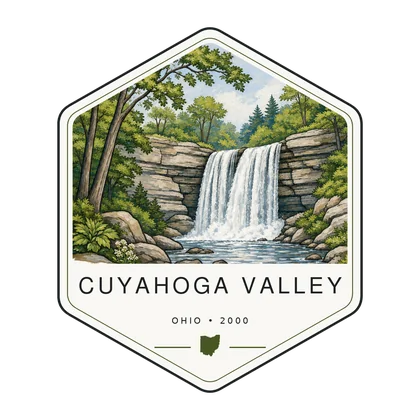
Log the visit, keep your story, and watch the map of all sixty-four fill in behind you. Every visit has a keepsake worth holding.
Another accessible, near-urban park proving you don't need to go remote for real wilderness.
Open Park 48 → PlanTurn Cuyahoga Valley into a trip with a custom, day-by-day itinerary.
Start planning → Go deeperThe 1969 river fire, a junkyard the beavers finished cleaning, and the last working lock on the Ohio & Erie Canal.
Read it → Explore moreFind your next park anywhere in the country.
Browse parks →
Offline maps, your passport, and every park in your pocket on the trail.
Join the waitlist →
The printed edition, part atlas, part journal, one story per park.
Notify me →Park-guide posters, enamel stamps, and the passport book to fill in.
Visit the shop →Field Notes
The parks do not perform for anyone. They stood here before the road, and they will stand here after it.