In the summer of 1900, two prospectors reached the edge of a glacier in the Wrangell Mountains and found a hillside so full of copper that one of them compared it, on the spot, to a green sheep pasture in Ireland. Within a decade it was the richest copper mine in the country. Within four decades it was empty.
Two Prospectors and a Green Hillside
Clarence Warner and Jack Smith, known to the other prospectors as "Tarantula" Jack, were working the eastern edge of the Kennicott Glacier in the summer of 1900 when they came across an outcrop of exposed rock, stained green from one end to the other. A geologist named Oscar Rohn had already guessed a deposit might sit somewhere along this exact contact zone, where limestone met greenstone. Warner and Smith had just found it.
Smith described what he'd seen to Stephen Birch, the mining engineer the two men brought in to assess it: "There's so much of the stuff sticking out of the ground that it looks like a green sheep pasture in Ireland." Samples pulled from what became known as the Bonanza Mine outcrop ran up to 70 percent pure chalcocite, an almost unheard-of concentration for copper ore. A typical American copper mine at the time was lucky to run 10 percent copper content at all.
It was, by any measure, one of the richest copper strikes anyone had ever found in North America. It just happened to be in one of the most remote places on the continent.
None of that made it a discovery, exactly. The Ahtna people had lived in the Copper River basin for at least a thousand years before Warner and Smith arrived, and they already had a word for what ran through these hills: chiti. It's the root behind the Chitina River's name, and, filtered through a chain of explorers, mapmakers, and one company's misspelling, eventually the root behind "Kennecott" too. Kennicott Glacier, and the town that grew up beside it, were named for Robert Kennicott, a 19th-century naturalist. When the Kennecott Copper Company incorporated, someone swapped the glacier's "i" for an "e," and the mistake outlived everyone who could have corrected it. Even reference books today sometimes get Robert Kennicott's own name wrong, still following an error made naming a company he never had anything to do with.
- Found SUMMER 1900, EASTERN EDGE OF KENNICOTT GLACIER
- Prospectors CLARENCE WARNER & JACK "TARANTULA" SMITH
- Ore grade UP TO 70% PURE CHALCOCITE (VS. ~10% TYPICAL)
- The name A MISSPELLING OF "KENNICOTT" THAT STUCK
Plan a Trip to Kennecott and McCarthy
The historic mill and mine buildings sit at the end of the McCarthy Road, deep inside the largest national park in the country.
Open the Trip PlannerA Company Town at the End of a Railroad
The Alaska Syndicate, backed by the Guggenheim and J.P. Morgan families, hired railroad builder Michael J. Heney in 1907 to solve the obvious problem: there was no way to move ore out of a mine this remote. Heney's crews spent four years laying track across glaciers, braided rivers, and canyon walls, eventually finishing 196 miles of railroad, including roughly 30 miles of trestle work, connecting the mine to the port town of Cordova. When the first train left Kennecott in 1911, ten days after the line was finished, it carried $250,000 worth of copper.
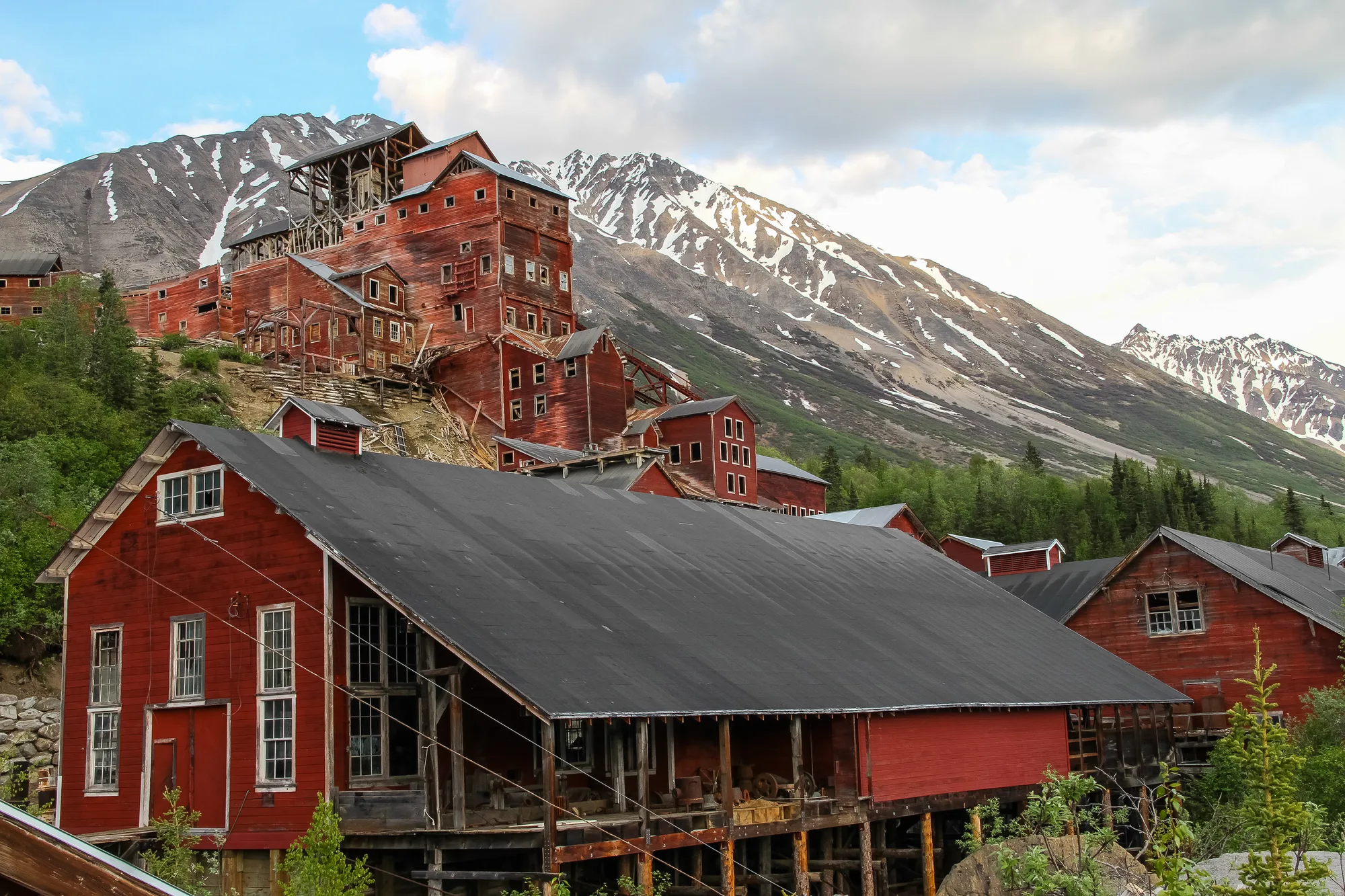
What grew up around the mine was a genuine company town, not just a work camp. Kennecott had a hospital, a general store, a school, a skating rink, a tennis court, a recreation hall, and its own dairy, serving around 300 mill workers plus another 200 to 300 miners. The mill itself was 14 stories tall, built directly into the mountainside so ore could move downhill through crushing, concentration, leaching, and flotation by gravity alone. It extracted 98 percent of the copper from the ore it processed, running 363 days a year.
Between 1911 and 1938, Kennecott's mines and mill processed roughly $200 million worth of copper, about $100 million of it profit.
By 1938, the highest-grade ore was running out, and the company simply stopped. The mill fell quiet, the town emptied, and the railroad that had cost four years and untold effort to build went unused. The National Park Service acquired the mill buildings and 2,800 surrounding acres in 1998, twelve years after Kennecott earned National Historic Landmark status. The hillside Jack Smith once compared to a green sheep pasture in Ireland is still green today, not with ore anymore, but with the copper-stained rock that's been sitting exposed on that mountainside since long before anyone thought to put a price on it.
- Railroad 196 MI · BUILT 1907-1911
- First shipment $250,000 IN COPPER, 1911
- Total processed ~$200M (1911-1938), ~$100M PROFIT
- Closed / Landmark / NPS 1938 · 1986 · 1998
Discovery story, ore grade, and Bonanza Mine details checked against the National Park Service's official Kennecott Mines National Historic Landmark page and its Kennecott history bulletin. Railroad construction, mill operations, workforce, and production figures checked against the same NPS sources. Ahtna history and the origin of the "chiti"/Chitina word checked against NPS's official human history article for Wrangell-St. Elias. The Kennecott/Kennicott spelling discrepancy checked against the University of Alaska Fairbanks Geophysical Institute's Alaska Science Forum.
What's left at Kennecott today is a National Historic Landmark, not a ruin exactly, the buildings have been stabilized and the mill can be toured, but it's unmistakably a place that stopped mid-sentence. The town's population went from several hundred to zero in a matter of weeks in 1938. Visitors now walk the same ground Warner and Smith stood on in 1900, looking at the same green-streaked rock, except now it comes with a gift shop instead of a mining claim.