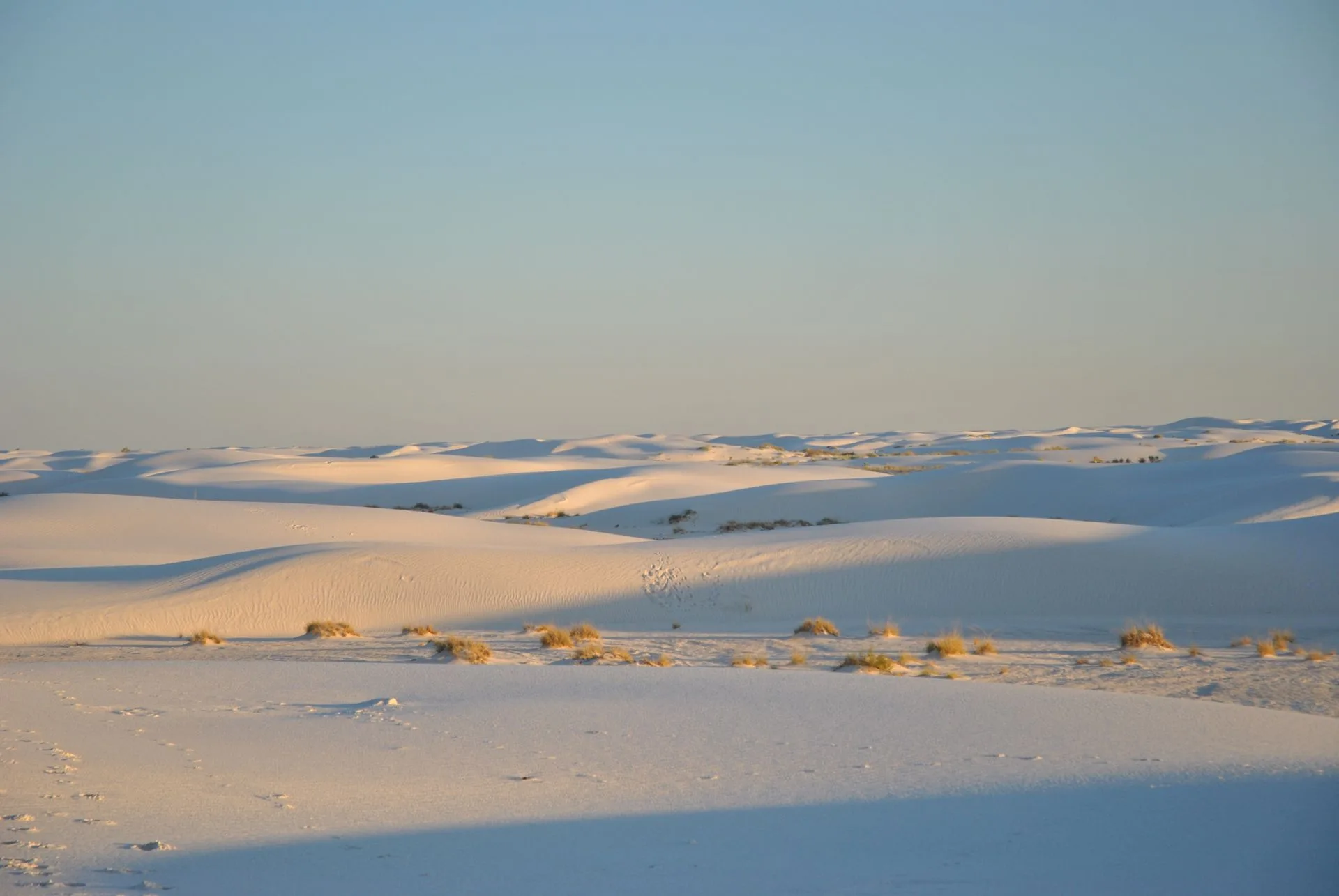
White Sands National Monument was established in January 1933, protecting a dune field already known for its startling white gypsum sand. It would be another twelve years before the U.S. military detonated the first atomic bomb on a bombing range roughly sixty miles to the north, and another eight years before that in 1941, before the Army even set up a permanent presence in this basin at all. The park didn't grow up next to a missile range. A missile range grew up around an already-protected park, and never let go.
That order of events, monument first, military installation second, atomic test third, shapes almost everything unusual about visiting White Sands today: the closures, the fence lines, the history most visitors never hear about on their way to the dunes.
A Protected Dune Field, Then a War
President Hoover established White Sands National Monument on January 18, 1933. It wasn't until 1941, after Pearl Harbor, that the U.S. military built a lasting presence in the Tularosa Basin, the beginning of what would become White Sands Missile Range and, nearby, Holloman Air Force Base. Four years after that, the Army detonated the world's first nuclear weapon on the same stretch of desert. White Sands wasn't redesignated a national park until December 20, 2019, meaning the monument-turned-park has spent the overwhelming majority of its existence next to, and increasingly boxed in by, a still-active military installation that arrived roughly a decade after it did.
The Test Itself
The Trinity Test went off at 5:29 in the morning on July 16, 1945, on the Alamogordo Bombing Range in an area historically called Jornada del Muerto, land the Army had already been using for conventional bombing training, which made it a convenient, already-restricted site to test something far more dangerous. The device, nicknamed the Gadget, sat atop a hundred-foot steel tower. The blast left a crater half a mile across and eight feet deep, fused desert sand into a glassy green mineral now called trinitite, and sent a mushroom cloud to thirty-eight thousand feet in about seven minutes. Estimates of the explosive yield have shifted over time, from roughly nineteen kilotons at the time to about twenty-one kilotons in later recalculations to nearly twenty-five kilotons in a 2021 re-analysis of the original rock samples using modern instruments, higher each time scientists looked closer. NPS's own materials place the site roughly sixty miles north of the park, though a separate NPS page gives sixty-five, a small discrepancy even the agency's own pages haven't reconciled.
Plan Your White Sands Visit
Trinity Site sits outside the park on missile range land, open to the public only once a year. The trip planner can help you time a visit around the open house or plan a separate trip focused on the dunes.
Open the Trip PlannerFourteen Dollars and Fifty Cents an Acre
Starting in 1942, the government began occupying area ranch land for wartime use, land held by local families through a mix of private ownership, state grazing leases, and federal grazing permits. For years afterward, some ranchers were allowed limited "co-use" of the land between military tests, and lease payments continued through 1970. That year, the government changed how it calculated compensation, stopped counting the value of federal grazing-permit land the way it always had, and began formal condemnation proceedings, followed by outright acquisition of the ranchers' private land starting in 1975.
The ranchers sued, arguing their land should have been valued as complete, integrated operations rather than piecemeal, the way a neighboring range had been handled in a comparable 1956 case, and that the government had promised to eventually give the land back. They lost. A federal court ruled the roughly fourteen dollars and fifty cents an acre the government paid was reasonable by comparison, and found no legal obligation for further compensation, stating plainly that any additional payment would be a gratuity, not something owed. The land is still active missile range today, more than eighty years after the first families were told to leave it.
Once a Year, If the Schedule Holds
Trinity Site opened to the public twice a year for decades, first Saturdays each April and October, until 2022 pushed the dates back a week for planning reasons. More recently, budget constraints cancelled the spring opening entirely, narrowing access to a single annual open house on the third Saturday of October, and even that single date wasn't guaranteed: the October 2025 opening, which would have marked the test's eightieth anniversary, was cancelled by a federal government shutdown. Ground Zero today reads at roughly ten times natural background radiation, and a one-hour visit exposes a person to a small fraction of what a single cross-country flight delivers, widely described as low risk for a brief visit. Anyone planning around this should confirm the current year's date directly with White Sands Missile Range before making the trip; the schedule has changed enough in the last few years that nothing here should be treated as fixed.
- Test date JULY 16, 1945, 5:29 AM
- Distance from park ~60-65 MI NORTH
- National Historic Landmark DESIGNATED 1975
- Public access ONCE YEARLY, OCTOBER, IF NOT CANCELLED
Facts and figures checked against the National Park Service's Trinity Site and White Sands Missile Range history pages, Department of Energy and Los Alamos National Laboratory materials on the test yield, and the federal court opinion in White Sands Ranchers v. United States for the land-compensation history. NPS's own pages disagree on the site's distance from the park (sixty versus sixty-five miles), reported here as a range rather than a single figure. The public-access schedule for Trinity Site has changed multiple times in recent years and was disrupted again in 2025; readers planning a visit should confirm the current date directly with White Sands Missile Range rather than relying on any published schedule, including this one.
The dunes at White Sands are older than the war that boxed them in, older than the bombing range, older than the fence lines that still run through what used to be someone's grazing land. The monument came first, a protected place that the military simply grew up around and never fully let go of. Ninety-three years later, most of what happened next is still restricted to one Saturday in October, if the schedule holds at all.