Great Smoky Mountains National Park draws roughly 13.3 million visitors a year, more than double the next-closest park, and it does that without charging anyone at the gate. There is no gate. Every one of the other most-visited parks in the country, Zion, Yellowstone, Grand Canyon, Yosemite, charges an entrance fee. The Smokies never has, and the reason has nothing to do with generosity.
It comes down to two roads and a piece of paper from 1951. That's worth knowing before anything else here, because it sets the tone for the rest of the park's history: the Smokies keep turning out to be shaped by decisions nobody visiting today would guess at, made by people who mostly aren't remembered for it.
Free by Deed, Not by Design
In 1951, Tennessee transferred Newfound Gap Road, the main route through the park, and Little River Road to the National Park Service. The deed for that transfer carried a condition: no tolls, on either road, ever. Tennessee wanted that written in because the roads mattered for ordinary travel between Tennessee and North Carolina, years before the interstate highway system existed to do that job instead.
A federal law that followed years later closed the loop: parks can't charge an entrance fee if tolls are barred on their primary access roads. Newfound Gap Road and Little River Road are exactly that, the roads most visitors actually drive through the park on, so the fee the Park Service could otherwise charge is blocked by a sentence written into a 1950s road deal. Nothing in the park's founding paperwork ever ruled out an entrance fee. This one deed, about roads, did it by accident.
The park does charge for some things. Camping fees have been in place since 1951. A parking tag, required for any vehicle parked more than fifteen minutes, started in March 2023, the closest thing to an entrance fee the park has ever had. But walk or drive straight through, and the Smokies remain the one major park in the country you can visit without paying to get in.
- Annual visitation ~13.3 MILLION
- Vs. #2 park (Grand Canyon) MORE THAN DOUBLE
- Entrance fee NONE, SINCE 1951 DEED
The Cove That Was a Community
Cherokee families lived across this land for generations before the Indian Removal Act, signed by Andrew Jackson in 1830, forced most Cherokee people west along what became the Trail of Tears. Some refused to go, hiding in the mountains and mountain coves instead. Their descendants form the Eastern Band of Cherokee Indians, based today on the Qualla Boundary just outside the park's southern edge.
Settlers moved into coves like Cades Cove through the 1800s, farming and building the log churches, cabins, and gristmills still standing there today. By the early 1900s, logging had taken over as the dominant industry, and it was industrial in scale: the Little River Railroad hauled timber out by the trainload, and companies like Champion Fiber cut deep into old-growth forest that had never been touched. Conservation-minded residents watched whole slopes get stripped and started pushing back, which is part of what eventually built momentum for a park. The Champion Fiber Company didn't settle its condemnation suit until 1931. The Little River Lumber Company kept logging inside what was already park land until 1938.
Cades Cove today reads as pastoral, a loop road past split-rail fences and white church steeples with the ridgeline behind them. It was a real place people built, farmed, and eventually lost, not a set piece assembled for the view.
Turn This Route Into a Real Plan
Pick your dates and your crew: the AI trip planner builds the day-by-day for the Smokies, drive times and trailheads included.
Open the Trip PlannerPennies, Bellhops, and a Rockefeller

Unlike most national parks, which were carved out of land the federal government already owned, the Smokies had to be bought, piece by piece, from thousands of private landowners and timber companies. That took money nobody had lined up in advance. Knoxville boosters, including pharmacist David Chapman and steel executive W.P. Davis, started the campaign in the early 1920s, and by 1926 the region had pledged over a million dollars toward it, from what one historical account describes plainly as "the pennies of school children, the dollar bills of hotel bellhops, and the hundreds and thousands of dollars pledged by regional elites."
President Calvin Coolidge authorized federal administration of the park on May 22, 1926, and North Carolina and Tennessee each committed two million dollars in state bonds the following year. It still wasn't enough. In 1928, John D. Rockefeller Jr. gave the final five million dollars needed to complete the land purchases, a gift made in memory of his mother, Laura Spelman Rockefeller. Even that didn't finish the job cleanly: Depression-era lawsuits and drained pledges stalled the effort until Franklin Roosevelt's administration stepped in with $1,550,000 by executive order in 1933, and Congress added another $743,265.29 on top of that.
Roosevelt dedicated the completed park on September 2, 1940, at Newfound Gap, on the state line between Tennessee and North Carolina, seventeen years after Knoxville boosters first floated the idea. A plaque at the overlook still credits the Rockefeller Foundation. It doesn't mention the schoolchildren, or the bellhops, but their pennies are in the park too.
- 1926 FEDERAL AUTHORIZATION; $1M+ ALREADY PLEDGED LOCALLY
- 1928 ROCKEFELLER'S $5M GIFT COMPLETES THE LAND FUND
- 1940 FDR DEDICATES THE PARK AT NEWFOUND GAP
Kuwohi
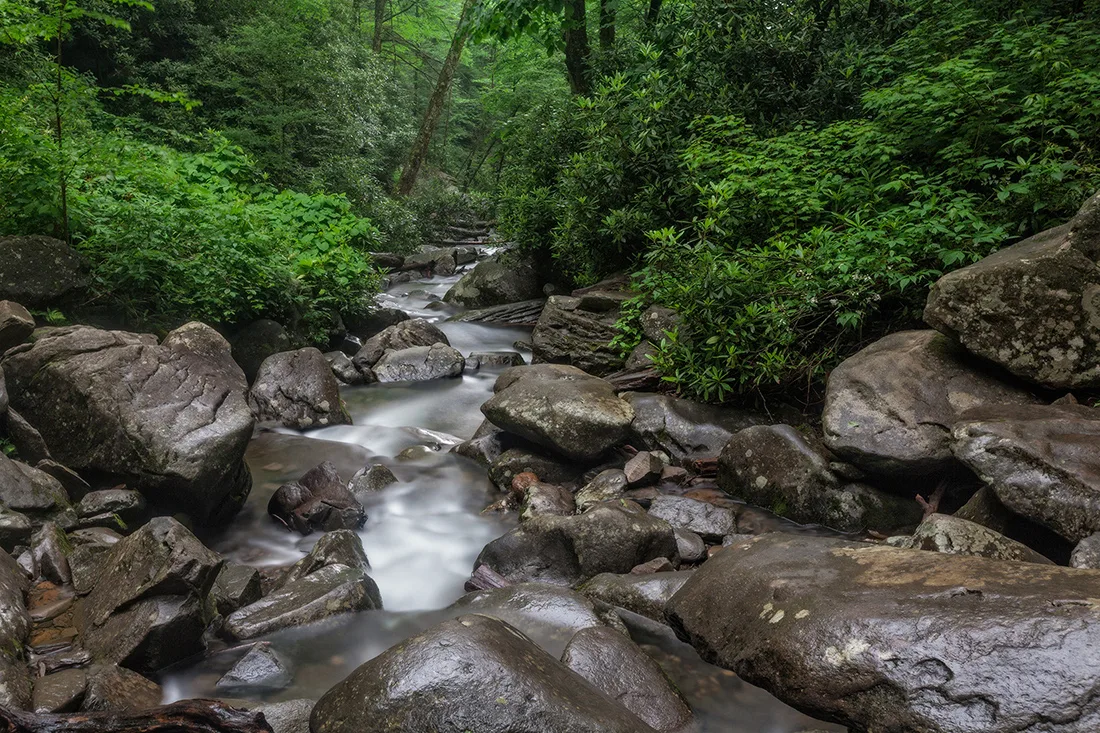
At 6,643 feet, the highest point in the park went by Clingmans Dome for 165 years, a name a geographer gave it in 1859 to honor Thomas L. Clingman, a politician who had explored and promoted the area. On September 18, 2024, the U.S. Board on Geographic Names officially restored its Cherokee name: Kuwohi, meaning "mulberry place."
Lavita Hill and Mary "Missy" Crowe, both members of the Eastern Band of Cherokee Indians, drafted the renaming legislation in 2022. The Tribal Council passed it that July, Buncombe County commissioners backed it unanimously the following month, and the National Park Service supported the change once the Eastern Band brought the application forward in 2024. Kuwohi holds particular significance in Cherokee tradition as a sacred site, one of the highest points the Cherokee people could still reach after removal took most of their homeland.
The mountain itself hasn't changed. A steep half-mile paved trail still climbs from the parking area to a 45-foot concrete observation tower, built in 1959, where a spiral ramp leads to a circular deck with a 360-degree view that can stretch 100 miles on a clear day. What changed is which name gets said out loud at the top of it.
What's Actually Underfoot
Great Smoky Mountains National Park holds 31 species of salamander across five families, enough to earn it the nickname "Salamander Capital of the World." Twenty-four of those species are lungless, breathing entirely through their skin and the lining of their mouths, an adaptation that only works in a place this consistently cool and wet. The park's range of elevation, from low stream valleys up past 6,000 feet, creates enough distinct micro-habitats to support that whole spread of species in one place.
Most are easy to overlook: the southern zigzag salamander is small enough to vanish into leaf litter the moment it stops moving. The eastern hellbender is the opposite kind of surprise, North America's largest salamander at up to 29 inches, an aquatic ambush predator that needs cold, clean, fast-moving water and rarely strays from one stretch of stream its whole life. Hellbender numbers are declining across their range, and the species is under consideration for federal endangered status.
None of this shows up in a typical trip photo. It's a reminder that the park's biggest superlative isn't the mountains or the crowds, it's what's living in the leaf litter and the streambeds that most visitors walk straight past.
The Two Reasons People Actually Come
The Smokies hold an estimated 1,500 to 1,900 black bears. Spread across the park's 800 square miles, that works out to roughly two bears per square mile, one of the densest bear populations anywhere in North America. Sightings are common enough along roads and in Cades Cove that "bear jams," the traffic backups that form when drivers stop to watch one, are practically routine. Give any bear the distance rangers ask for and carry bear spray if you're heading into the backcountry. The density that makes sightings likely is the same density that makes carelessness a real risk.
The other draw runs on a much tighter schedule. For about two weeks in late May or early June, the Photinus carolinus firefly synchronizes its flash pattern near Elkmont, thousands of fireflies blinking in unison rather than at random, one of only a handful of synchronous firefly species in the world and the only one in the Americas. The Park Service has capped visitor access since 2006 to protect both the experience and the fireflies' mating window, and getting in now means winning a lottery: a few days each spring, recreation.gov opens applications for a limited number of vehicle passes, selected at random, for a one-dollar application fee and a twenty-nine-dollar reservation fee if you're picked. It is, by a wide margin, the hardest reservation to get anywhere in the park that costs nothing to enter.
The Crowds Are the Trade-Off
Free entry and easy access from three major cities make the Smokies the most-visited park in the country by a wide margin, and that means trailheads fill early, Cades Cove Loop Road can take two hours to drive at peak season, and the historic buildings survive only because visitors don't touch what's original. Go early, expect company, and treat the cabins, churches, and mills the way you would any structure that's been standing since before the park existed: look, don't lean.
Facts and figures checked against NPS.gov, including the park's fee-free legal history, the 1926-1940 funding and founding timeline, the 2024 Kuwohi renaming, and current bear and firefly-lottery guidance. Visitation is an annual average; where a specific year's count is cited, it's noted as such above.