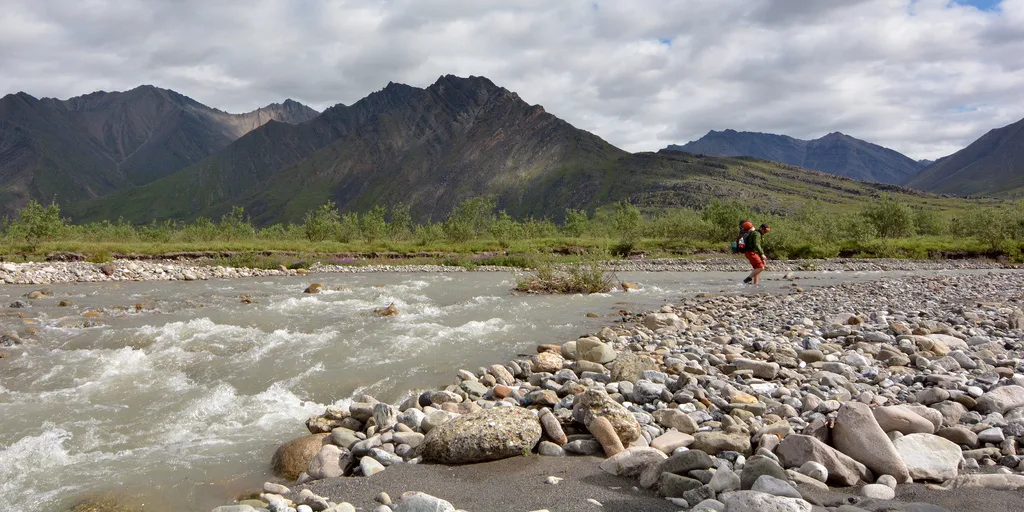
Draw a boundary around Gates of the Arctic National Park and one dot lands inside it: Anaktuvuk Pass, a village of a few hundred people sitting in the only natural break in the central Brooks Range wide enough to walk a caribou herd through. Everywhere else in the park, roughly eight million acres of it, there are no roads, no trails, and no towns. Anaktuvuk Pass is the one exception, and it exists there because it was never actually inside anything until the map caught up with it.
The Families Who Came Down From the Mountains
The Nunamiut, an inland Iñupiat people, had followed caribou through the central Brooks Range on a seasonally nomadic pattern for generations before anyone wrote the name Anaktuvuk Pass on a map. By the middle of the twentieth century, most Nunamiut bands had already left the mountains for coastal trading posts, but a handful of families kept to the old pattern longer than the rest. In 1949, roughly five families came in from a camp near Chandler Lake and another group of about eight families arrived from the Killik River drainage, and together they settled at the pass permanently rather than moving on with the season.
A bush pilot named Sigurd Wien is credited with encouraging the settlement, flying supplies and mail into the pass and helping convince the scattered Nunamiut bands that a fixed village, with a school and a landing strip, was worth trading the full nomadic circuit for. The pass itself was the draw on its own merits: it sits directly on the migration route of the Western Arctic Caribou Herd, which meant a village built there could keep hunting caribou without following them across the entire range. Within a few years, Anaktuvuk Pass had a store, a school, and a name that translates roughly to "the place of caribou droppings," a bluntly practical description of exactly what made the location worth staying at.
- People NUNAMIUT, INLAND IÑUPIAT
- From Chandler Lake ~5 FAMILIES
- From the Killik River ~8 FAMILIES
- Year settled 1949
- Name meaning ROUGHLY "PLACE OF CARIBOU DROPPINGS"
Plan a Gates of the Arctic Trip
Anaktuvuk Pass is the park's only village, and for most visitors, its only bush-plane gateway on the north side of the range.
Open the Trip PlannerA Village the Park Had to Build Around
Gates of the Arctic became a national park and preserve in 1980 under the Alaska National Interest Lands Conservation Act, and by the time that boundary was drawn, Anaktuvuk Pass had been an established village for three decades. Rather than route the park around it, ANILCA folded the community in as the only settlement inside Gates of the Arctic's boundaries, with subsistence hunting, fishing, and gathering rights for local residents written into the law itself. A 1996 land exchange later transferred additional acreage to the Nunamiut Corporation, the village's Alaska Native corporation, giving residents clearer title to land immediately around the community.
That subsistence right isn't a formality. Caribou, Dall sheep, and fish from the surrounding rivers still make up a real share of what families in Anaktuvuk Pass eat, hunted on land that happens to also be federally protected wilderness. The Simon Paneak Memorial Museum, founded in the village in 1986, keeps that history visible to the handful of visitors who make it this far north; it's named for Simon Paneak, a Nunamiut elder, historian, and self-taught ecologist who died in 1975 and whose own written and oral records of Nunamiut life and caribou movement became a genuine resource for later researchers and the park itself. The museum holds skin sewing, tools, and caribou-skin mask work alongside Paneak's own records, a village's own account of itself sitting inside the park it predates.
- Park established 1980, ANILCA
- Status ONLY COMMUNITY INSIDE THE PARK BOUNDARY
- Land exchange 1996, NUNAMIUT CORPORATION
- Simon Paneak Memorial Museum FOUNDED 1986
- Access BUSH PLANE FROM FAIRBANKS OR COLDFOOT
Anaktuvuk Pass's 1949 settlement, its status as the only community inside Gates of the Arctic, and the park's 1980 establishment checked against the National Park Service's own history of the village and the park. The Simon Paneak Memorial Museum and Simon Paneak's own history checked against the National Park Service and published sourcing on the museum.
Every other boundary line on the Gates of the Arctic map runs through country with no people in it at all, which is largely the point of the park. Anaktuvuk Pass is the one place that line had to bend around something that was already there, a village built at the one gap in the mountains wide enough for a caribou herd, and for the families who'd been following that herd, wide enough to finally stop.