
For about two weeks each spring, thousands of male fireflies in Congaree's floodplain forest flash in the same instant, go dark together, and do it again.
This Isn't the Same Species as Great Smoky Mountains
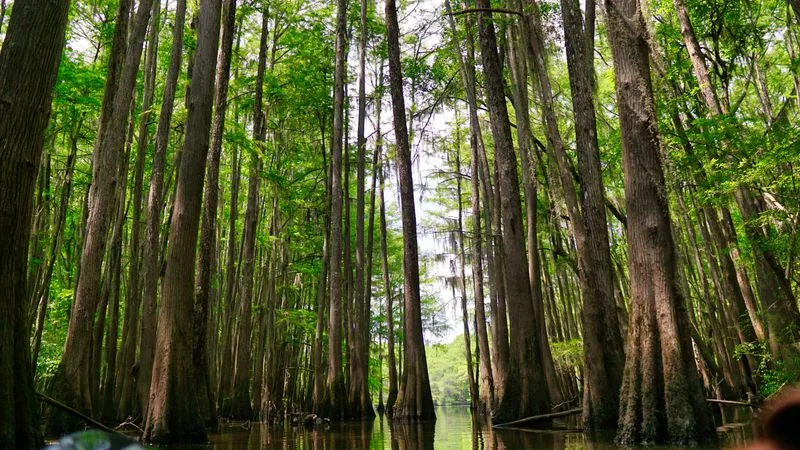
Congaree's synchronous fireflies are Photuris frontalis, sometimes called the "snappy sync" firefly for its quick, sharp flash pattern. That makes it a different species entirely from Photinus carolinus, the firefly responsible for the famous synchronized display at Great Smoky Mountains National Park. The two shows aren't the same phenomenon happening twice, they're two unrelated species that independently evolved a similar trick.
The males flash in quick unison bursts, roughly every 0.6 to 1.0 seconds depending on the temperature, then go dark together for a pause before starting again. Researchers describe the pattern as intermittently synchronous rather than perfectly metronomic, a wave of light that rolls across the floodplain forest floor in pulses rather than one clean, continuous pulse. The display runs for roughly a one-hour window starting after sunset, with peak viewing usually falling between about 9 and 10 p.m.
Plan Your Congaree Visit
The firefly event is one of the most in-demand nights on the park's calendar. Plan well ahead of the viewing window.
Open the Trip PlannerYou Need a Reservation, and the Window Is Short
Congaree's synchronous fireflies typically appear for about a two-week stretch somewhere between mid-May and early June, though the exact dates shift year to year with temperature and rainfall, and the park doesn't finalize them far in advance. For the 2026 event, Recreation.gov lists the viewing dates as May 13 through May 20, with only 145 vehicle passes issued per night and a limit of 8 people per vehicle. A pass costs 25 dollars: a 24 dollar event fee plus a 1 dollar non-refundable service fee. Day visitors are required to exit the park by 4:30 p.m. during the event, ahead of the evening's managed access.
Because demand for passes far outpaces supply, checking Recreation.gov as soon as a given year's dates and lottery window are announced is the only reliable way in. Outside the official event window, the fireflies are still present in the park in smaller, less synchronized numbers, but the reserved, ranger-supported viewing is what the park actually built for the peak nights.
- Species PHOTURIS FRONTALIS ("SNAPPY SYNC")
- Typical window ROUGHLY MID-MAY TO EARLY JUNE
- 2026 event dates MAY 13-20 (RECREATION.GOV)
- Passes per night / fee 145 PASSES · $25 ($24 + $1 SERVICE FEE)
The species identification and its distinction from Great Smoky Mountains' Photinus carolinus checked against NPS.gov's Congaree firefly research and viewing pages. Flash-timing details checked against the same NPS sources. The 2026 event dates, pass count, per-vehicle limit, and fee checked directly against the event's Recreation.gov listing. Typical seasonal timing is described as an approximate range rather than fixed calendar dates, since the park itself does not commit to exact dates far in advance.
Most firefly displays fade the moment you start paying close attention to them, a few scattered blinks that never quite add up to a show. Congaree's don't work that way. Stand in the floodplain forest during that hour after sunset and the light stops looking random: it rolls, pulses, goes dark, and rolls again, thousands of tiny signals agreeing on the same instant for reasons that still aren't fully understood. The reservation system exists because that hour is worth protecting.