Santa Elena Canyon Trail
Easy–Mod
1.6 mi+80 ft~1.5 hr
A crossing of Terlingua Creek followed by a climb into the canyon mouth, ending where the river meets the towering walls. No permit.
 National
Texas · Park 30 / 64
Desert, river, and an entire mountain range inside one boundary, folded into a bend of the Rio Grande.
Big Bend takes its name from the sharp turn the Rio Grande makes here, and the park it contains is really three landscapes folded into one boundary: the Chihuahuan Desert, the Rio Grande itself, and the Chisos Mountains, the only mountain range entirely contained within a single national park. The Chisos rise cool and green out of the surrounding desert floor, dropping temperatures enough to make a summer afternoon there survivable in a way the lowlands aren't.
Santa Elena Canyon is the park's signature sight, where the river has cut a gorge with walls rising 1,500 feet straight up, Mexico on one side and the United States on the other, narrow enough in places that you could nearly touch both countries at once. A planned two-year closure of the Chisos Basin lodge and facilities, originally set to begin May 2026, was cancelled in April 2026 due to budget shortfalls, so the basin, its trails, and its campground remain open.
Come for the canyon and the river. Stay for the fact that this remote a park, this far from anywhere, has some of the darkest skies and quietest nights left in the country. Read the story, trust the live data above for what is open today, and when you leave, mark it visited.

There is no place else like it on this planet. There is just the one Big Bend.Adapted from journalist and Texas writer commentary on Big Bend's founding
Six ways to spend your time, from a 1,500-foot canyon on the border to a natural hot spring beside the river.
A short trail crossing Terlingua Creek and climbing into a gorge with sheer 1,500-foot walls on both sides of the Rio Grande.
The signature walkThe only mountain range fully contained inside a national park, with its own cooler microclimate and iconic view called The Window.
Everyone · half dayA historic riverside hot spring accessible by a short trail, with the Rio Grande running cool right beside the warm pool.
Everyone · half dayA paved road through desert badlands and volcanic formations, ending near Santa Elena Canyon.
Casual · road-trippersAmong the least light-polluted skies in the contiguous United States, with the Milky Way visible without any equipment.
Stargazers · after darkA legal, official border crossing inside the park lets visitors visit the small Mexican village of Boquillas del Carmen with a passport.
Half day · passport requiredAnswer a few questions right here. We'll map your day, stop by stop, with a route, timings, weather, and a packing checklist grounded in real park data. No account, no leaving this page.
⚡ In a hurry? Adventure Light 5 questions →Every trail rated honestly, with distance, climb, and a note on which mountain, desert, or river zone it belongs to.
A crossing of Terlingua Creek followed by a climb into the canyon mouth, ending where the river meets the towering walls. No permit.
A descent from the Chisos Basin to a natural pour-off framing a desert view, the park's signature Chisos hike. No permit.
A short riverside walk to a historic hot spring with foundations still visible. Rough access road; high-clearance recommended. No permit.
A climb from the Chisos Basin to views into Juniper Canyon and south toward Mexico, one of the park's most rewarding day hikes. No permit.
A sandy desert walk to Balanced Rock, a distinctive rock formation framing the desert beyond. No permit.
A full-day loop to the Chisos Mountains' South Rim, with views stretching deep into Mexico. A wilderness permit is required only for overnight camping.
No permit for day hikes · free backcountry permits via Recreation.gov for overnight camping · high-clearance vehicle recommended for Hot Springs Road
Tap any animal to learn its story. Soon, the app will let you log what you spot and keep a life list for every park.
Disappeared from the park for decades before naturally recolonizing the Chisos Mountains from Mexico in the 1980s, now a resident population.
Reintroduced after disappearing in the mid-1900s, now working the rocky desert terrain throughout the park.
A common ground-dwelling bird across the Chihuahuan Desert sections of the park, fast enough to outrun most predators on foot.
Present throughout the mountain and desert terrain, rarely seen but occasionally reported near trails in the Chisos Basin.
Native to the Rio Grande and its tributaries, occasionally visible basking on rocks along the riverbank.
Males wander the desert each autumn in search of mates, a common and harmless sight on park roads at dusk.
A pig-like mammal traveling in small family groups through the desert scrub, more closely related to peccaries than true pigs.
A spindly, cane-like shrub that erupts in bright red flowers after rain, common across the desert floor throughout the park.
A rare bluebonnet species nearly endemic to this region, blooming along desert washes in early spring after good winter rain.
Survives on cool, north-facing slopes in the Chisos Mountains, a relic pocket of a wetter, cooler climate that once covered more of the region.
A spiky, low-growing agave considered a defining plant of the Chihuahuan Desert, common across the park's lower elevations.
Lines the riverbank through Rio Grande Village and Santa Elena, providing the park's most reliable shade near the water.
Spends decades as a low rosette before sending up a single towering flower stalk once in its lifetime, then dies.
The Chisos Mountains are the only mountain range entirely contained within a single national park in the United States.
Santa Elena Canyon's walls rise roughly 1,500 feet above the Rio Grande at their tallest point.
A planned two-year closure of the Chisos Basin, set to begin in May 2026, was cancelled that April due to budget shortfalls; the basin remains open.
Big Bend is home to more bird, bat, butterfly, cactus, and reptile species than any other U.S. national park.
The questions people actually ask, answered from the park’s own current guidance. Fees and permit rules change every year, so each answer links back to the National Park Service page it came from.
A private vehicle pass costs $30 and is good for 7 days for everyone in the car. A motorcycle pass runs $25, and if you're walking or biking in it's $15 per person. America the Beautiful annual, senior, and access passes are accepted at the gate. Source: NPS.gov
You don't need a reservation just to drive into the park, standard entrance fees apply at the gate any day. Camping is different: every developed campground is reservation-only now, there's no first-come, first-served camping left in the park. If you're headed into the backcountry or floating the river overnight, you also need a backcountry permit, which costs $10 a night and can be booked through Recreation.gov. Source: NPS.gov
Yes, the Boquillas Crossing port of entry lets you cross the Rio Grande into the village of Boquillas, Mexico. A valid passport is required for everyone, no exceptions. It's open Friday through Monday, 9 am to 4 pm, in summer months, and Wednesday through Sunday, 9 am to 4 pm, in winter, so check the current schedule before you plan a crossing. Source: NPS.gov
Stories, guides, and hard-won tips from the trail. The full Big Bend deep dive lives on the blog.
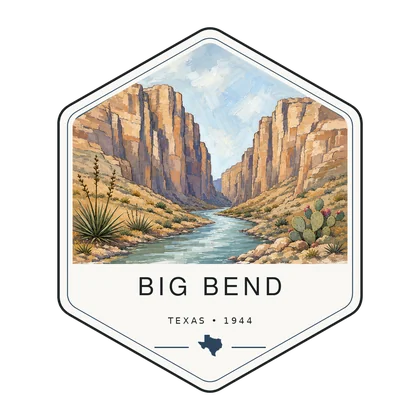
Log the visit, keep your story, and watch the map of all sixty-four fill in behind you. Every visit has a keepsake worth holding.
See the full map and track every park you have visited.
View the map → PlanTurn Big Bend into a road trip with a custom, day-by-day itinerary.
Start planning → Go deeperBig Bend holds some of the darkest measured skies in the continental United States. The Milky Way here casts a shadow.
Read it → Explore moreFind your next park anywhere in the country.
Browse parks →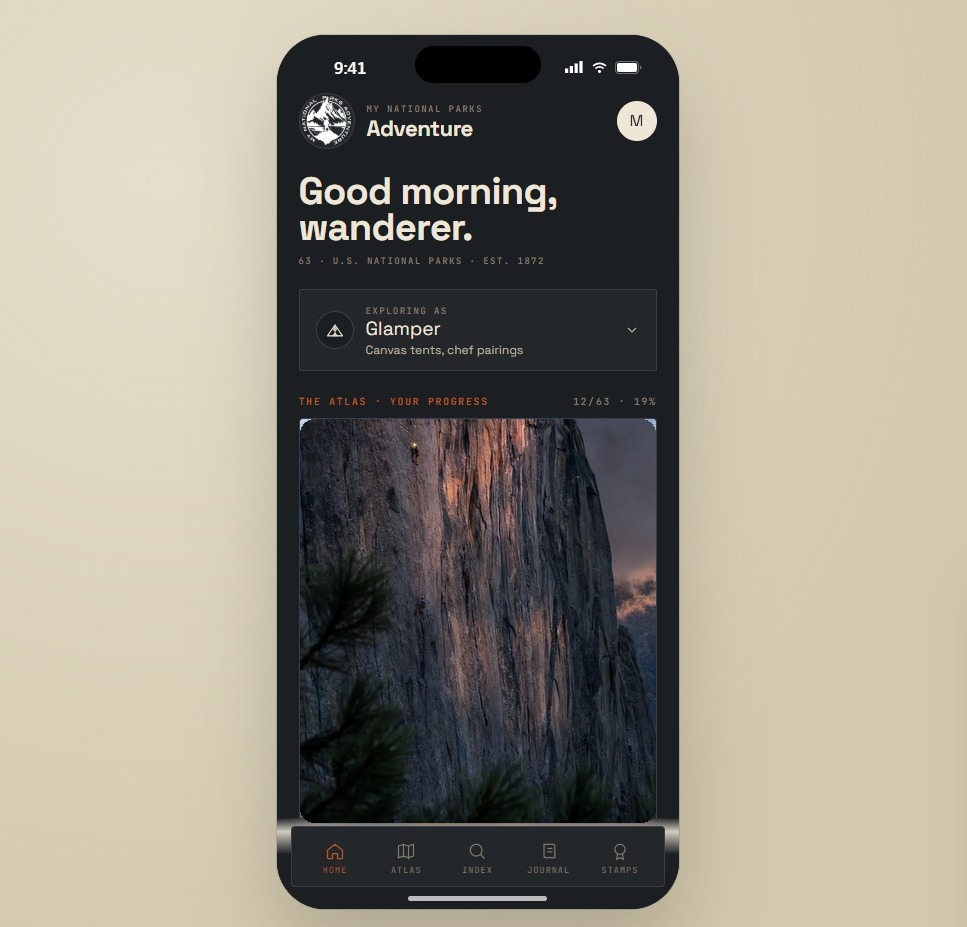
Offline maps, your passport, and every park in your pocket on the trail.
Join the waitlist →
The printed edition, part atlas, part journal, one story per park.
Notify me →Park-guide posters, enamel stamps, and the passport book to fill in.
Visit the shop →Field Notes
The parks do not perform for anyone. They stood here before the road, and they will stand here after it.